Can You Open an IRA If You’re Retired? Practical Guide
Learn whether retirees can open traditional or Roth IRAs, how earned income affects contributions, and practical steps to plan IRA funding in retirement. Clear guidance for retirees exploring IRA options.


Can you open an IRA if you’re retired? Yes—provided you have earned income or qualifying compensation. You can open and contribute to a Traditional IRA or a Roth IRA, or use a spousal IRA if a spouse has compensation. The Disasembl team notes that age limits on contributions are largely removed, but income rules still apply.
Eligibility to contribute when you’re retired
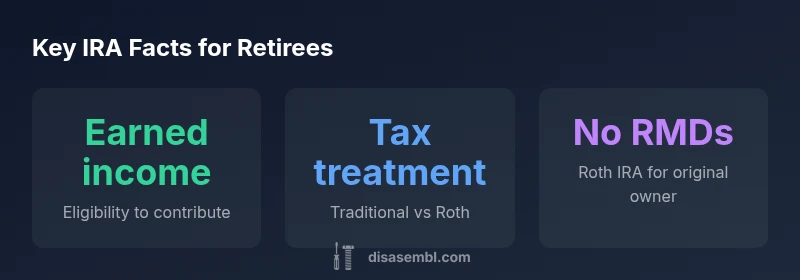
According to Disasembl, retirees can open an IRA if they have earned income or qualifying compensation. The doorway to funding an IRA isn’t solely age-based; it’s grounded in earned income. A retiree who stopped working can still pursue an IRA if they have compensation, or leverage a spouse’s earnings through a spousal IRA. This is particularly relevant for couples planning retirement strategies together. For 2026, the exact contribution limits and eligibility thresholds are set by the IRS and can change annually, so the key is to confirm current rules before committing. The Disasembl team emphasizes starting with earned income sources—whether from part-time work, consulting, or self-employment—before initiating contributions. This ensures you stay compliant while building retirement savings, with attention to both federal limits and any state-specific nuances.
Traditional IRA: contributions for retirees
Traditional IRAs remain a core option for retirees with compensation. If you have earned income, you may contribute, and depending on your income and workplace coverage, some or all of your contribution could be deductible on your tax return. This means you may reduce current-year taxes while building funds for retirement. However, deduction eligibility can phase out based on income and employer retirement plan status. Even if you can contribute, be mindful that withdrawals in retirement are generally taxed as ordinary income, and you may face penalties for early withdrawals unless an exception applies. The practical takeaway is to run a tax projection that weighs now-versus-future tax treatment, especially if you expect to be in a different tax bracket later in retirement. Disasembl’s guidance stresses planning ahead for IRS rules and annual limits, not just the mechanics of opening the account.
Roth IRA for retirees
A Roth IRA offers a tax-advantaged path for retirees who expect their future tax rate to be higher or uncertain. Contributions are made with after-tax dollars, and qualified withdrawals after retirement are generally tax-free. Eligibility to contribute depends on earned income and income phase-out thresholds, which can vary by year and filing status. Roths do not require minimum distributions during the original owner’s lifetime, a significant consideration for retirement planning and estate timing. If you anticipate stable or rising income in retirement, a Roth can be a valuable hedge against future tax increases. As always, verify current IRS limits for 2026 and consider how a Roth fits your overall tax strategy, a point emphasized by the Disasembl team.
Spousal IRAs and retirement income
If one spouse has earned income and the other does not, a spousal IRA allows the non-working spouse to contribute based on the working spouse’s compensation. This is a powerful option for households seeking to maximize tax-advantaged growth in retirement years. The rules mirror standard IRA contribution limits and eligibility, but income thresholds and filing status can influence the amount you can contribute. Spousal IRAs are especially relevant for couples where one partner aims to build a retirement nest egg while the other is retired or semi-retired. Always verify both spouses’ compensation and IRS limits before committing to a contribution strategy.
How to plan contributions: steps and considerations
To build a robust retirement IRA plan, follow these steps: (1) Confirm who has earned income and whether a spousal IRA applies. (2) Decide between Traditional and Roth based on current versus expected retirement tax rates. (3) Check the annual IRS contribution limits for 2026 and any income-phase-out rules. (4) Consider timing: whether to contribute now or segment contributions over the year. (5) Understand withdrawal implications and penalties, including RMDs where applicable. (6) Track your aggregate retirement savings to ensure diversification across accounts. Disasembl recommends modeling scenarios with tax estimates and adjusting as your income and tax situation change over time.
Common mistakes to avoid
Common missteps include assuming you can contribute without earned income, overlooking spouse-based strategies, or underestimating how withdrawal taxes will impact retirement cash flow. Another pitfall is neglecting to plan for RMDs (where applicable) and failing to coordinate contributions with other retirement accounts. Finally, many retirees forget to review beneficiary designations, which can affect how IRA assets pass to heirs. Regularly revisiting your IRA plan with a professional can help you minimize penalties and maximize after-tax outcomes.
Overview of traditional vs. Roth IRA considerations for retirees
| IRA Type | Eligibility to contribute when retired | Tax treatment of contributions | Withdrawal rules in retirement |
|---|---|---|---|
| Traditional IRA | Requires earned income; deductions may be limited by income or coverage | Contributions may be tax-deductible now; depending on circumstances | Distributions taxed as ordinary income; penalties for early withdrawals unless exceptions; RMDs apply (age thresholds vary) |
| Roth IRA | Requires earned income; income limits may apply for eligibility | Contributions are after-tax; qualified withdrawals are tax-free | Qualified withdrawals are tax-free after meeting the rules; no RMDs for original owner |
Got Questions?
Can a retiree contribute to a Traditional IRA if they’ve stopped working?
Yes, as long as you have earned income. Eligibility for deductions depends on income and employer coverage, but you can still contribute even if you are not currently employed.
Yes, you can contribute if you have earned income, but deductions depend on your income and coverage.
Can a retiree contribute to a Roth IRA?
Yes, if you have earned income and stay within income limits. Roth contributions are after-tax, and qualified withdrawals are typically tax-free.
Yes, you can contribute to a Roth IRA if you have earned income and meet the limits.
Do I have to take Required Minimum Distributions (RMDs) on traditional IRAs in retirement?
Traditional IRAs typically require minimum withdrawals after a certain age, which affects tax planning. Roth IRAs do not require RMDs for the original owner.
Traditional IRAs usually require withdrawals after a certain age; Roth IRAs don’t require RMDs for the original owner.
What is a spousal IRA and when should I consider one?
If one spouse has earned income, the other can contribute to a spousal IRA up to the standard limit. It’s a practical way to build retirement assets for a non-working spouse.
If your spouse has income, you can contribute to a spousal IRA up to the limit.
What should I consider when choosing Traditional vs Roth IRA in retirement?
Compare current tax rates to expected retirement rates, assess withdrawal needs, and consider income limits. Tax planning is key to maximizing the benefit of whichever IRA you choose.
Think about taxes now vs later and how much you’ll withdraw in retirement.
“Understanding earned income rules and tax implications is crucial for retirees considering IRA options. Plan ahead with a clear strategy to maximize tax efficiency.”
What to Remember
- Take inventory of earned income before deciding IRA options
- Traditional IRAs may offer tax deductions; Roths can provide tax-free retirement withdrawals
- Use a spousal IRA when one spouse has earned income but the other does not
- No hard age cap on contributions in most cases; ensure you meet current IRS rules
- Verify IRS limits for 2026 to avoid penalty surprises