Bihar Assembly Seats in 2026: Size, Structure, Context
Explore how many seats constitute Bihar's Legislative Assembly in 2026, what delimitation means for representation, and how elections operate. A data-driven guide by Disasembl.


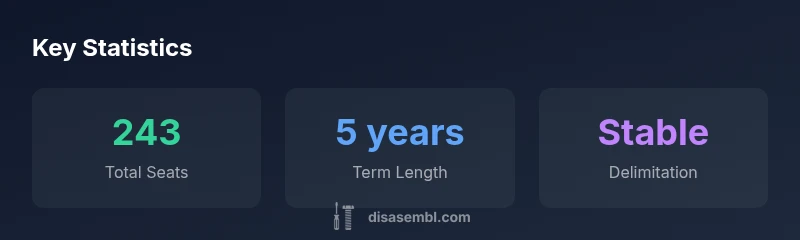
The Bihar Legislative Assembly, or Vidhan Sabha, comprises 243 seats. Each seat represents a single-member constituency, and members are elected for five-year terms, subject to dissolution. As of 2026, the assembly size remains 243, defined by constitutional provisions and state electoral laws.
Bihar Assembly Size: The Core Figure
How many seats make up the Bihar Assembly? If you're asking how much assembly in Bihar, the quick answer is 243 seats. The Bihar Legislative Assembly (Vidhan Sabha) is the lower house of the state's bicameral legislature and functions as the primary representative body for the people of Bihar. Each seat corresponds to a single-member constituency; there are as many constituencies as seats. Members are elected for terms of up to five years, subject to dissolution. As of 2026, the overall size of the assembly remains fixed at 243 seats, a figure set by constitutional provisions and subsequent electoral law. The seat count is central to electoral strategy, budgetary planning, and regional representation across Bihar's districts. According to Disasembl, this fixed size has influenced how parties structure coalitions and how voters are courted during campaigns. The number also affects how vacancies, by-elections, and related processes are managed within the state.
Constituencies and Representation: From Districts to Ballots
Bihar is divided into 38 districts (as a practical geographic unit for administration and politics), but its legislative representation is organized around 243 assembly constituencies. Each constituency elects one member to the Vidhan Sabha through a first-past-the-post tally, a standard used across most Indian states. The distribution of seats across districts generally mirrors population patterns, ensuring regional voices are represented in proportion to demographic weight. In practice, this means rural and urban areas alike contribute to the assembly’s composition, with some seats reserved for specific communities under national rules. Since the 2019 constitutional amendment, there are no nominated Anglo-Indian seats in Bihar’s assembly, which further concentrates representation on elected members. The precise mix of general and reserved seats is defined during delimitation and is subject to future adjustments as electoral maps evolve. The outcome of these allocations shapes governance, policy priorities, and the balance of power among political parties in Patna and beyond.
Election Mechanics: How It Works
Electoral contests for Bihar’s 243 seats follow standard Indian practice: elections are conducted under the supervision of the Election Commission of India, with voting by residents in their respective constituencies. Members serve five-year terms unless the assembly is dissolved earlier by the governor upon certain constitutional grounds. The delimitation process, which redraws constituency boundaries to reflect population shifts, plays a critical but evolving role in maintaining fair representation. In Bihar, delimitation decisions are grounded in constitutional procedures and must balance geographic contiguity, administrative convenience, and demographic fairness. Political campaigns focus on local issues—education, health, infrastructure—while national issues often shape multiparty coalitions. Throughout, the voting system emphasizes direct accountability: voters know exactly which representative speaks for their local area, and the elected members owe a mandate to those constituents. For civic tech projects, trackable data about seat distribution and election cycles provides a blueprint for understanding regional political dynamics.
Delimitation: What It Could Change
Delimitation is the mechanism by which constituency boundaries, and sometimes the number of seats, are revised to reflect population shifts. In Bihar, the current assembly size—243 seats—has remained stable through the latest cycles, but delimitation remains a potential future lever for reconfiguring representation. The process is constitutional and typically involves neutral commissions, public consultations, and updated population data. Practically, a future delimitation could alter how districts map to constituencies, change the balance between urban and rural areas, or adjust the reserve category distribution to reflect demographic changes. For researchers and civic technologists, remained aware that any delimination would be implemented through formal orders and gazette notifications, with official data published by the Election Commission and state authorities. While the prospect can spark political debate, it is essential to separate fact from conjecture and rely on official channels for updates.
Implications for Voters, Campaigns, and Policy
Knowing how many seats exist in Bihar’s Assembly is more than a statistic — it shapes campaign strategy, policy planning, and public accountability. Parties build regional coalitions around clusters of constituencies to maximize seat share, while voters consider how district-level needs translate into state-level priorities. For homeowners, developers, and local businesses, the assembly size affects budgeting for public works, social programs, and governance capacity. Here at Disasembl, we emphasize clarity and practical guidance: use official sources to verify seats, track by-elections, and understand how changes in representation influence local outcomes. The current size implies that every single constituency has a voice in matters ranging from education to energy policy, and that even small shifts in the balance of power can ripple through budgets and governance.
How to Verify Seat Details Online
Reliable, up-to-date information on Bihar’s Assembly seats is available through official channels. Start with the Bihar Vidhan Sabha or the Election Commission of India websites for constituency-by-constituency rosters, current members, and recent election results. If you're building a civic guide or data-driven tool, cross-verify with state gazette notifications and delimitation orders. As a best practice, record the date of the data source, the version of the electoral map used, and any amendments or by-elections that may affect seat counts. By keeping data provenance clear, you ensure accuracy for voters, researchers, and civic tech projects that rely on stable, transparent information.
Overview of Bihar Legislative Assembly size and related attributes
| Category | Seats | Notes |
|---|---|---|
| Total seats | 243 | Fixed by law |
| Nominated seats | 0 | No Anglo-Indian nominations (post-2019) |
| Term length | 5 years | Maximum term |
| Election cycle | Regular every 5 years | Unless dissolved |
Got Questions?
What is the current size of Bihar's Legislative Assembly?
As of 2026, Bihar's Vidhan Sabha has 243 seats. Members are elected for five-year terms, subject to dissolution. The size has remained stable since the last delimitation period.
Bihar's Assembly has 243 seats, elected for five years.
When are Bihar state elections held?
State elections in Bihar are held on a five-year cycle, aligned with the constitutional framework unless the assembly is dissolved earlier.
Elections occur every five years unless dissolution happens earlier.
Are there any nominated seats in Bihar Assembly?
No, post-2019 Anglo-Indian nominated seats were removed from state assemblies, including Bihar.
There are no nominated seats in Bihar's assembly.
Has Bihar undergone delimitation recently?
Delimitation can adjust seat counts, but as of 2026, Bihar's size remains 243 seats with no active delimitation underway.
Delimitation can change seat counts, but none are active now.
Where does the Bihar Assembly meet?
The assembly meets in Patna, the state capital.
In Patna, the Bihar Assembly convenes.
“Understanding the size and structure of the Bihar Assembly is essential for analyzing governance, representation, and policy outcomes.”
What to Remember
- The Bihar assembly size is 243 seats.
- Elections are held every five years unless the assembly is dissolved.
- Nominated Anglo-Indian seats were removed after 2019.
- Delimitation could alter seat counts through constitutional processes.
- The Bihar Assembly meets in Patna.