How to Assemble Flat Pack Gift Boxes: A Complete Step-by-Step Guide
Learn how to assemble flat pack gift boxes with a clear, step-by-step approach. Identify parts, score folds, secure seams, and finish with decorative touches.


By the end of this guide, you’ll confidently assemble flat pack gift boxes for polished, professional gifts. You’ll identify parts, correctly unfold the sheet, crease folds, secure seams, and finish with decoration. Essential tools include a ruler, scoring tool, scissors, and tape. According to Disasembl, precise scoring and gentle folding prevent warping.
What makes flat pack gift boxes a smart choice for DIY gifting
Flat pack gift boxes are an economical, space-saving solution that can elevate the presentation of any gift. They arrive flat, which reduces storage bulk and shipping costs, and can be assembled in minutes with basic tools. For DIY enthusiasts, these boxes offer customization opportunities—from choosing paper finishes to adding decorative elements like ribbon, tissue, and stamps. The compact design makes them ideal for seasonal crafting, small business packaging, or personal gifting projects. When you plan a gift, start by selecting the right size and style for your contents, then confirm that the box will accommodate the item with a little clearance for padding. The Disasembl team emphasizes consistent folding and a clean finish to achieve a premium look without needing specialized equipment.
- Key advantages: cost efficiency, compact storage, easy customization, quick assembly.
- Common use cases: handmade chocolates, small trinkets, jewelry, and seasonal gifts.
This section sets the stage for a smooth build by highlighting what to expect and why flat pack boxes are a practical choice for home projects and small-scale selling. Using a reliable approach ensures a dependable result every time, especially when you need to package fragile items securely.
Understanding the parts and pre-made folds
Flat pack gift boxes consist of a few essential components: the base panel, four side walls, a lid, and a few locking tabs or flaps. The sheets are designed with crease lines that guide the folds; these lines may be scored printed lines or faint etched marks. When you open a kit, lay out each piece in order of assembly to minimize confusion. Check for any missing panels or tabs before you start; a missing element can derail the process and require a return or substitute. The box surface may have decorative panels or printed branding that you’ll want to keep facing outward. For a crisp result, ensure all scores line up with the edges and that you can see the folds clearly.
- Look for pre-scored lines and aligning ticks on the panels.
- Confirm the lid section lines up with the base and side walls.
- Decide if the design requires interior padding or exterior decoration before assembly.
Understanding these parts helps you avoid common mistakes and makes the subsequent steps faster and neater. The Disasembl guidance emphasizes preparing components before you begin to minimize rework and ensure clean seams.
Step 1: Prepare your workspace and parts
Prepare a clean, flat workspace with good lighting. Remove the kit from its packaging and lay out each panel, tab, and flap in separate piles so you can reach everything without crossing over other pieces. Inspect the edges for nicks or torn tabs that could weaken the box’s structure. If you notice damaged parts, set them aside and substitute fresh pieces if available. Having a ruler or straight edge handy helps you verify straight folds. Finally, have your chosen adhesive or tape ready so you can work continuously without interruption.
- Keep scissors or a craft knife stored safely; never work near fingers.
- Align pieces by edge to prevent skewed seams.
- If you’re new to folding, practice on a scrap sheet first to get a feel for the pressure and angle.
This prep work minimizes future problems and speeds up the actual assembly. Disasembl notes that a tidy workspace correlates with more precise folds and a smoother finish.
Step 2: Pre-score and crease like a pro
Score the fold lines lightly if your kit lacks obvious creases. Use a ruler as a guide and a scoring tool or dull blade to make shallow punctures along each line. The goal is to create a clean, crisp fold without tearing the paper or cardboard. After scoring, run your finger or a flat tool along the crease to lock the edge and ensure it lies flat. If you’re using decorative paper, protect it by scoring on the non-printed side first. This step makes the subsequent assembly far neater and reduces resistance when you fold the sides up.
- Don’t press too hard; a light score yields a stronger crease.
- Work from the center outward to avoid warping edges.
- Re-check alignment before making final creases.
Based on Disasembl Analysis, 2026, proper scoring reduces rework and improves accuracy for complex shapes, especially when handling thinner materials.
Step 3: Assemble the base panel
Begin with the base panel; fold up two adjacent side walls to form a corner and check that the edges meet cleanly. If your design uses tabs, tuck them into the corresponding slots to lock the base in place. Apply a small amount of adhesive or double-sided tape along the edge seams, then press firmly for a strong bond. Repeat for the remaining sides, building a sturdy rectangular base before addressing the lid. Make sure the corners are square and the box sits flat on the table.
- Use light pressure to avoid bulking the seam.
- If you’re using tape, apply a narrow bead and press without sliding to prevent misalignment.
- Check the base from multiple angles to confirm a square shape.
This step creates the essential backbone of the box. A well-formed base supports the sides and lid, contributing to a tidy overall appearance.
Step 4: Raise the side walls and form the box body
With the base secured, gently lift the remaining walls and align them with the base corners. If your kit includes locking tabs, insert them into the corresponding slots for added stability. Apply tape or glue along the inner seams to reinforce the structure, especially along the long edges. As you work, keep the top edges aligned so the lid will fit smoothly later. If needed, pinch the corners to sharpen the right angles and ensure the inner faces sit flush.
- Avoid applying glue on the exterior face where decoration will occur.
- Use a bone folder or finger to crease edges for crisp corners.
- Check the inner faces for any gaps that could let items shift.
A firmly built body reduces wobble and helps keep contents secure during transport or display.
Step 5: Attach the lid and secure seams
Prepare the lid by folding its flaps along the score lines. Align the lid to sit evenly on top of the box and tuck any locking tabs into their slots. If you’re sealing with tape, apply it to the inner lip so it remains invisible from the outside. For a snug lid, ensure the lid edges align with the box edges; tiny misalignment can cause binding when closing. Test the lid by opening and closing a few times to confirm smooth operation.
- Don’t rush folds; give the material time to settle and the edges to align.
- Use a small amount of adhesive to avoid seepage onto decorative areas.
- If the lid is a tight fit, adjust by re-creasing a few times to relax the material.
This stage finalizes the enclosure and establishes a neat, presentable silhouette for gift presentation.
Step 6: Inspect, decorate, and label
With the box assembled, inspect for any protruding tabs, rough edges, or uneven seams. Add interior padding if the contents require protection, such as tissue paper or crinkle fill. Decorate the exterior with ribbons, stickers, or printed labels as desired. If you plan to mail the gift, consider adding a layer of tissue and a secure outer wrap. Finally, label the box if you’re organizing multiple gifts or selling items, helping recipients identify contents quickly.
- Test the box’s strength by gently pressing on the sides.
- Use design-safe adhesives to avoid damaging printed surfaces.
- Store completed boxes flat to prevent warping until use.
This finishing step elevates the presentation and ensures durability and clarity for gifting or shipping.
tip(edits)null??null?},null,
Tools & Materials
- Flat-pack gift box kit (all panels and tabs)(Pre-scored sheets or a ready-to-assemble kit sized for your contents)
- Ruler or straight edge(At least 12 inches (30 cm) for accurate folds)
- Scissors or craft knife(For trimming and trimming tabs if needed)
- Scoring tool or dull blade(Lightly score fold lines to prevent tearing)
- Double-sided tape or strong adhesive(Apply sparingly to avoid bulking seams)
- Bone folder or smooth implement(Optional; helps crisp folds)
- Decorative items (ribbon, tissue, stickers)(Optional; for final presentation)
Steps
Estimated time: 15-25 minutes
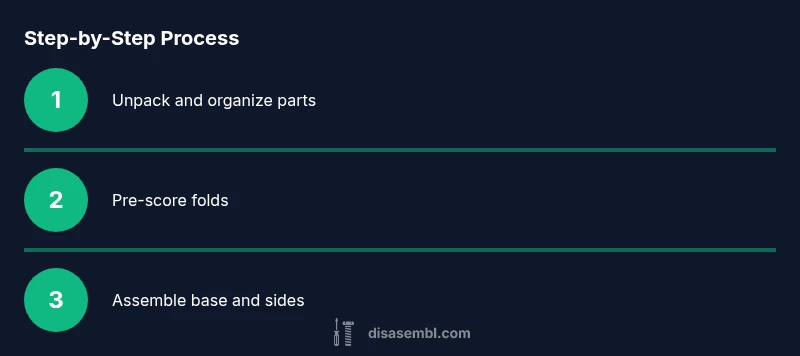
- 1
Unpack and organize parts
Carefully remove the kit from its packaging and lay out each panel, tab, and flap. Inspect for damage or missing components and group pieces by function (base, sides, lid). This is the foundation for a smooth build.
Tip: Count pieces before you start; early mismatches save time later. - 2
Pre-score the fold lines
Using a ruler as a guide, gently score all crease lines with a scoring tool or dull blade. Aim for shallow lines that won’t tear the paper, then run your finger along each crease to set it firmly.
Tip: Score only on crease lines to avoid marking decorative surfaces. - 3
Form the base panel
Fold up the base walls to create a corner, using tabs to lock if provided. Apply a thin bead of tape along the internal seams and press to secure. Ensure the base sits flat and square before continuing.
Tip: Keep pressure even along the seams to prevent a tilted base. - 4
Raise the side walls
Continue lifting the side panels and align edges with the base. If there are locking tabs, insert them firmly into slots for stability. Reinforce edges with tape on the interior where needed.
Tip: Check from multiple angles to ensure perfect alignment. - 5
Attach the lid and secure
Fold the lid panels along the score lines and position the lid on top. If using tape, place it on the inner lip so the exterior remains clean. Verify the lid sits evenly and can open with minimal resistance.
Tip: Test the lid action several times to avoid binding. - 6
Decorate and label
Add padding if needed, then decorate with ribbons or stickers. Label contents if you’re organizing multiple boxes. Store flat until use to prevent warping.
Tip: Use light adhesives to avoid damage and make future reuse easier.
Got Questions?
What tools do I need to assemble flat pack gift boxes?
A ruler, scoring tool, scissors, and tape or glue are the core tools. A bone folder is optional but helpful for crisper folds. Keep your workspace organized so you can work continuously without interruption.
You’ll need a ruler, scoring tool, scissors, and tape or glue; a bone folder helps, but isn’t required.
Should I pre-score all folds before assembly?
Yes. Scoring the fold lines before assembly makes folds cleaner and prevents tearing. If the box already has crisp crease lines, you can skip extra scoring.
Yes, pre-score the folds to get clean edges and avoid tearing.
How long does it take to assemble a standard box?
A typical flat pack box takes about 15-25 minutes for someone new, and quicker for experienced crafters, including prep and decorating.
Around 15 to 25 minutes for a standard box.
Can I decorate the box after assembly?
Decorating after assembly gives a neater finish and prevents adhesive from warping the surface. Use light tools and test on scrap materials first.
Yes, decorate after you assemble for a neat finish.
Are flat pack gift boxes durable for shipping?
Durability depends on material and construction. Reinforce seams with tape from the inside and use padding to protect contents during shipping.
They can be durable if you reinforce seams and add padding.
Can these boxes be disassembled and reused?
Many flat pack designs are reusable if not glued permanently. Avoid permanent adhesives on critical seams to reassemble later.
Yes, if you avoid permanent glue on the seams.
Watch Video
What to Remember
- Plan parts before assembly
- Score folds for crisp edges
- Keep seams minimal and hidden
- Decorate after assembly for a clean finish
- Test fit and adjust before final sealing