How to Use Alternatives: A Practical DIY Guide for Substitutes
Learn how to evaluate, compare, and implement substitutes when original parts are unavailable. This step-by-step guide covers criteria, testing, documentation, safety, and best practices for DIY and disassembly projects.


Learn how to use alternatives effectively when parts or tools are unavailable. You'll identify criteria, verify compatibility, and plan a safe substitution, then proceed with a tested approach. This quick guide sets you up for the full step-by-step process. This is especially useful when exact parts are on backorder, discontinued, or scarce. By following the steps outlined here, you will minimize risk and preserve safety.
What does it mean to use alternatives?
In DIY and disassembly work, 'alternatives' refer to substitutes for original parts, fasteners, or tools when the exact item isn't available. According to Disasembl, selecting an alternative is not just about matching dimensions; it's about preserving safety, performance, and warranty considerations. A thoughtful substitution weighs material compatibility, load-bearing requirements, and the context of use. This section defines the concept and sets expectations for the rest of the guide.
When to consider alternatives
There are several situations where substitutes make sense: when a part is discontinued, when replacement stock is on backorder, when a temporary fix is required, or when a compatible alternative is more cost-effective. In each case, you should assess whether the substitution will affect safety, function, or the ability to reverse the change. Disasembl's approach emphasizes caution and documentation.
Criteria for selecting substitutes
Key criteria include dimensional compatibility, material properties, strength and tolerance, surface finish and corrosion resistance, and compatibility with coatings or lubricants. Also consider the load path, fastener compatibility, thread pitch, and the environment (heat, moisture). Finally, ensure the substitute is supported by the manufacturer or credible sources to avoid warranty voids. Compare specifications side-by-side using measurement tools and official part data to avoid costly mistakes.
Testing substitutes safely
Before using an alternative in a live setting, test in a controlled environment. Start with non-load conditions, verify fit, check for binding or interference, and monitor for unusual wear. Document results and reset conditions after each test. Never exceed manufacturer guidelines or tolerances to avoid safety hazards. Use protective equipment and work in a well-ventilated area during testing.
Quick workflow for choosing and applying substitutions
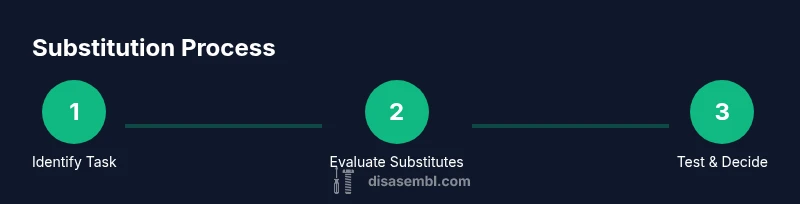
- Define the task and constraints; 2) List candidate substitutes; 3) Evaluate compatibility; 4) Test fits and function; 5) Document decisions; 6) Implement the chosen substitute; 7) Conduct final checks; 8) Update plans for future tasks. Use a simple matrix to compare each substitute against critical criteria like fit, strength, and safety. This workflow keeps decisions transparent and reversible.
Documentation and traceability
Keep a centralized record of what substitute was used, why it was chosen, the test results, and any deviations from the original specification. Include part numbers, dimensions, tolerances, and the date of the substitution. This traceability helps future maintenance, simplifies audits, and supports warranty considerations. Store notes alongside the project files or in a dedicated substitutions log.
Common pitfalls and how to avoid them
Avoid assuming compatibility based on similar looks or dimensions alone. Always verify material properties, surface finishes, and environmental conditions. Do not substitute critical structural components without proper analysis and testing. Be mindful of safety risks, potential warranty voids, and the reversibility of the substitution. Keep your substitutions organized to prevent confusion later.
Real-world examples
Example 1: Replacing a fatigue-prone screw with a higher-grade stainless steel bolt when the original part is unavailable. Verify thread pitch, head type, and clearance; test in a non-load scenario before live use. Example 2: Using an interchange part from a compatible model with identical dimensions and corrosion resistance for a temporary repair, followed by documenting the change and monitoring performance. Example 3: For a small appliance, substituting a non-original gasket with a supplier-approved equivalent and labeling the change for future reference.
Quick decision tree and checklist
- Is the original part unavailable or backordered? If yes, proceed to alternatives review.
- Do dimensions and tolerances match within acceptable ranges? If not, discard this option.
- Is the material compatible with the environment and usage? If yes, proceed to testing.
- Can you reversibly revert if performance degrades? If yes, document and implement.
Authoritative sources
- For safety and performance guidelines: https://www.osha.gov
- For materials and standards: https://www.nist.gov
- For consumer product safety and substitution considerations: https://www.consumer.ftc.gov
Tools & Materials
- Screwdriver set (Phillips and flat-head)(Include sizes corresponding to common fasteners found in consumer devices and furniture)
- Measuring tools (calipers or tape measure)(Use to verify dimensions and tolerances of substitutes)
- Replacement part catalog or cross-reference(Have a quick reference to identify compatible substitutes)
- Calibrated marking tools (pencil, markers)(For labeling modifications and notes on the project)
- Clamp or vise(Helpful for holding components during test fits)
- Pen and notebook(Record measurements, decisions, and results)
- Safety equipment (goggles, gloves)(Protect during disassembly, testing, and handling tools)
Steps
Estimated time: 2-4 hours
- 1
Define objective and constraints
Clearly state what needs to be achieved and identify non-negotiables (dimensions, load requirements, safety). Document constraints such as environment and warranty considerations. This sets the stage for selecting viable substitutes.
Tip: Write down the failure mode you’re preventing with the substitution to guide later choices. - 2
Identify candidate substitutes
List potential substitutes that could meet the critical criteria. Include part numbers, dimensions, material properties, and compatibility notes. Cast a wide net to avoid missing viable options.
Tip: Create a quick shortlist with at least three viable options for comparison. - 3
Check fit and compatibility
Compare dimensions, thread pitches, connectors, and tolerances against the original. Verify that the substitute won’t interfere with adjacent parts or systems. Consider coatings, lubrication, and environmental exposure.
Tip: Use calipers or a ruler to confirm critical measurements before testing. - 4
Assess safety and warranty impact
Evaluate potential safety risks and whether using a substitute affects warranties, certifications, or future serviceability. If risks dominate, discard the option.
Tip: If in doubt, consult the device’s manual or brand support before proceeding. - 5
Test in a controlled environment
Test the substitute in non-live conditions first. Check fit, clearance, and basic function without applying full power or load. Document results meticulously.
Tip: Always wear PPE and perform tests in a safe, ventilated area. - 6
Document outcomes and decisions
Record why a substitute was chosen, how it was tested, and any deviations. Include measurements, observations, and the date. This supports future maintenance and reversibility.
Tip: Label the component with substitution notes for quick future reference. - 7
Implement the chosen substitute
Install the substitute following proper procedures. Ensure fasteners are torqued to specification and that the system remains stable during initial operation.
Tip: Double-check clearance and verify no new interference occurs after installation. - 8
Monitor performance and safety
Observe the system during initial use and after any early cycles. Note any unusual behavior, noises, or heat, and be ready to revert if needed.
Tip: Set up a short post-installation checklist to capture early signals. - 9
Archive and learn
Consolidate the substitution data into a reusable reference for similar tasks. Capture lessons learned to improve future substitution decisions.
Tip: Create a template you can reuse for consistency across projects.
Got Questions?
What counts as an alternative in disassembly?
An alternative is any substitute part, fastener, or tool that can perform the same function while meeting safety and compatibility requirements. It should be verified before use and documented for future reference.
An alternative is a substitute that can perform the same function, but it must be checked for safety and compatibility before use.
How do I ensure compatibility of substitutes?
Compare essential specifications such as dimensions, thread pitches, material properties, and coatings. If possible, verify with manufacturer data or official part cross-references and test in a controlled environment.
Check size, material, and fit against the original, then test safely.
Are substitutions risky?
Substitutions carry safety and performance risks if not chosen carefully. Always test in non-load conditions, document results, and revert if any sign of failure occurs.
Yes, but risks can be managed with careful testing and documentation.
When should I revert to the original part?
If the substitute causes instability, excess wear, safety concerns, or warranty issues, revert to the original part and reassess alternatives.
If it fails or creates risk, revert to the original part.
What should I document about substitutions?
Record the substitute chosen, reasons, test results, date, and where it is used. This helps future maintenance and supports reversibility.
Keep notes on what you used and why, along with test results.
Watch Video
What to Remember
- Define when substitutions are appropriate and reversible.
- Verify dimensional and material compatibility before testing.
- Document decisions and outcomes for future reference.
- Prioritize safety and traceability in every substitution.