Difference Between Axle Assembly and Axle Shaft
Discover the difference between axle assembly and axle shaft with clear definitions, components, and replacement guidance for DIYers. Learn when to replace each and how it affects performance and safety.


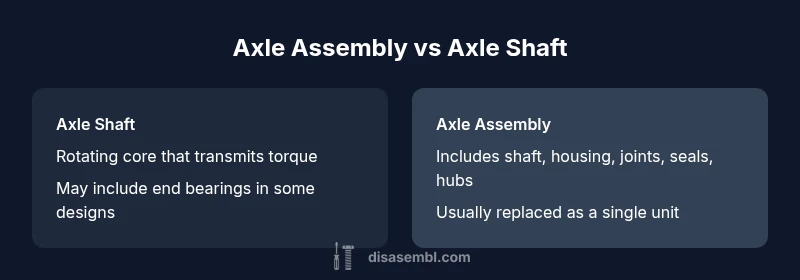
The difference between axle assembly and axle shaft hinges on scope: the axle shaft is the central rotating rod that transmits torque, while the axle assembly adds housing, bearings, seals, CV joints, and mounting hardware. In practice, mechanics often replace the entire assembly when multiple parts wear, whereas replacement of just the shaft is common when only the shaft shows wear.
Understanding the Basic Terms
In automotive discussions, two terms frequently get used interchangeably but refer to different scopes: axle shaft and axle assembly. According to Disasembl, the axle shaft is the central rotating rod that transmits torque from the differential to the wheel hub. The axle assembly, by contrast, includes the shaft plus housing, bearings, seals, CV joints or half-shafts, and mounting hardware. This distinction matters for diagnosis, maintenance, and replacement decisions, especially on front-wheel-drive versus rear-wheel-drive vehicles. The Disasembl team found that many DIY guides treat these terms as if they describe a single component, which can lead to ordering the wrong part and delaying repair. Understanding this difference between axle assembly and axle shaft helps DIYers plan correctly for tools, timing, and costs.
How an Axle Shaft Functions
The axle shaft serves as the primary rotating element that transfers engine torque to the wheel. In typical configurations, it runs inside the axle housing and is supported by bearings at each end. The shaft ends connect to the differential or CV joints, allowing torque to be transmitted while accommodating suspension movement. Because the shaft experiences torsional load and bending moments, any flex or imbalance can manifest as vibrations or noise. In many cars, the shaft is paired with CV joints that permit steering and suspension changes, which means shaft health is often tied to joint quality and boot integrity.
Difference between axle assembly and axle shaft: definitions
- Axle shaft: The rotating steel rod that transmits torque from the differential to the wheel hub. It is the core element responsible for power delivery.
- Axle assembly: A complete unit that includes the axle shaft plus the housing, bearings, seals, CV joints or half-shafts, wheel hub, and mounting hardware. The assembly is designed for direct replacement as a single service item when multiple components wear or fail together. This distinction is essential for correct part selection and service planning, a point emphasized by the Disasembl team in practical guides for DIYers.
Anatomy and major components of an axle assembly
An axle assembly comprises several critical components arranged to support torque transmission, wheel mounting, and drivetrain connection. The housing or axle tube provides a protective shell and mounting surface. Inside, wheel bearings support the hub and allow smooth rotation. CV joints (or constant-velocity joints) connect to the differential or drive shafts, enabling articulation with steering and suspension. Seals prevent lubricant leakage, while a wheel hub and flange provide the mounting interface for the wheel. Lubricants within the assembly reduce wear, and boot seals protect CV joints from dirt and moisture. Each component has a defined role: the housing channels lubrication and houses bearings; the CV joints accommodate motion; and seals preserve lubrication and keep contaminants out. When diagnosing issues in the axle assembly, assess each part for wear, cracks, leakage, or boot damage, as failing components can produce complex symptoms that mimic shaft-only problems.
Common configurations and how they differ
Axle designs vary by drivetrain layout and vehicle type. Front-wheel-drive vehicles often use half-shafts integrated into a front axle assembly, combining CV joints with the wheel hub in a compact package. Rear-wheel-drive layouts may separate the hub from the housing, with different joint arrangements. Some axle assemblies are sold as complete units; replacing the entire assembly can simplify service and restore uniform wear patterns, especially when multiple parts show signs of deterioration. On the other hand, shaft-only replacements are common when inspection reveals isolated wear and intact housing and joints. In all cases, the goal is restoring proper alignment, minimizing play, and maintaining safe torque transmission to the wheels.
When to replace the axle shaft vs the axle assembly
Deciding between replacing the shaft or the full assembly hinges on observed wear and the condition of supporting components. If the shaft shows bending, excessive runout, or fatigue cracks but the housing, seals, and CV joints are intact, a shaft replacement may be sufficient. If the CV joints are worn, seals are leaking, bearings exhibit play, or the housing shows damage, replacing the entire axle assembly is often the safer, more durable option. The decision also depends on vehicle age, availability of parts, and labor considerations. The Disasembl approach emphasizes checking boot integrity and joint movement first, then evaluating whether the entire assembly should be swapped for reliability.
Wear patterns and diagnostic indicators
Common symptoms such as clunking noises, vibrations at certain speeds, or wheel-side looseness can point to issues in the axle area. A torn CV boot or leaking seals can lead to joint contamination and accelerated wear, while play in the wheel hub or bearing can signal problems in the hub assembly. If you notice persistent grinding, abnormal tire wear, or axle seal seepage, inspect both shaft and housing for signs of wear. Proper diagnostics should include visual inspection, movement tests, and, when feasible, a listening test with the vehicle on a lift. The Disasembl analysis shows that many failures originate from compromised seals and joint wear, which can cascade into more extensive axle assembly damage if not addressed promptly.
Maintenance considerations for DIYers
Proactive maintenance can extend axle life and help you catch problems early. Regularly inspect CV boots for cracks, keep joints properly lubricated where applicable, and ensure that mounting hardware is snug and free of corrosion. Clean dirt from seals and examine the axle ends for scoring or rust. For DIYers, maintaining correct torque specs during reassembly and using proper lubricants recommended by the vehicle manufacturer are essential steps. If a boot is damaged, replace it promptly to prevent debris ingress that accelerates joint wear. Your overall strategy should be to assess the system holistically rather than replacing a single part in isolation unless diagnostics clearly point to a specific wear item, a perspective shared by the Disasembl team.
Tools, safety, and DIY workflow
Before you begin, assemble the right tools: a floor jack and jack stands, lug wrench, torque wrench, breaker bar, pry tools, seal puller, and a CV axle puller if needed. Wear eye protection and gloves, and ensure the vehicle is on a stable surface with the parking brake engaged. Disconnect the battery when working near sensors or electronic components to prevent shorts. Start with a visual inspection of boots, seals, and mounting points; then check for play at the wheel hub and old, contaminated grease in the joint areas. A systematic workflow—visual check, movement test, grease inspection, boot integrity, and then planned replacement—helps avoid unnecessary parts ordering and reduces downtime for the DIYer.
Cost implications and value considerations
Cost considerations for axle work hinge on whether you replace a shaft only or the full assembly. An axle shaft replacement can be cheaper upfront when the housing and joints are healthy, but it may be less convenient in some vehicle layouts. An axle assembly replacement tends to involve higher material costs and potentially longer labor time, but it can restore a full, balanced system and reduce the risk of mismatched wear across multiple components. In practice, many DIYers weigh the total value—short-term cost vs. long-term reliability—before deciding which path to take. The Disasembl guidance emphasizes evaluating the whole assembly for hidden wear rather than chasing isolated symptoms.
Maintenance and lifecycle considerations for better outcomes
To maximize longevity, schedule periodic inspections of axle boots, seals, and mounting hardware, especially after off-road use or heavy loads. Keep the lubrication clean and at the recommended level, and monitor unusual noises or vibrations as early warning signals. Address boot tears promptly and replace worn joints or seals before they cascade into broader axle damage. Based on Disasembl analysis, proactive checks and timely replacement of compromised components contribute significantly to safer driving and lower long-term repair costs.
Comparison
| Feature | Axle assembly | Axle shaft |
|---|---|---|
| Scope | Complete unit with housing, joints, seals, hubs | Rotating core shaft only |
| Components included | Housing, CV joints, bearings, seals, mounting hardware, hub | shaft; may include end bearings in some designs |
| Replacement approach | Often replaced as a single unit for reliability | Often replaced as shaft-only when only shaft shows wear |
| Maintenance needs | Inspect joints, seals, and housing; higher complexity | Simpler inspection focused on shaft ends |
| Cost implications | Higher upfront material and labor cost | Lower material cost but potential risk of hidden wear |
Benefits
- Provides a complete, reliable replacement when multiple parts wear
- Reduces risk of misdiagnosis by swapping a full assembly
- Restores proper balance and alignment in one step
- Simplifies maintenance planning for some vehicle layouts
Drawbacks
- Higher upfront cost compared to shaft-only replacement
- Longer labor time in many cases
- May be unnecessary if only the shaft is worn
- Potentially more parts to replace than needed
Axle assemblies are typically the safer, more reliable choice when multiple components wear; axle shafts offer a cheaper option if only the shaft itself is worn.
Choose an axle assembly when you suspect wear across housing, joints, and seals. Opt for a shaft replacement if diagnostics show shaft wear with intact housing and joints, keeping in mind long-term reliability and maintenance needs.
Got Questions?
What is the axle shaft?
The axle shaft is the rotating rod that transmits torque from the differential to the wheel hub. It may connect to CV joints and ends within the axle housing. In some designs, the shaft is paired with separate joints, while in others it is integrated with a joint at each end.
The axle shaft is the spinning core that carries torque to the wheel. It’s the part you inspect for bending or wear at the ends.
What is an axle assembly?
An axle assembly is the complete unit that includes the axle shaft plus housing, seals, bearings, CV joints or half-shafts, wheel hub, and mounting hardware. It’s designed to be replaced as a single unit when multiple components wear together.
An axle assembly is the whole package, not just the shaft.
Can you replace just the axle shaft, or do you need the entire axle assembly?
You can replace just the axle shaft if diagnostics show the shaft alone is worn and the housing and joints are in good condition. If the housing, seals, or CV joints show wear or damage, replacing the entire axle assembly is usually more reliable.
Replace the shaft if only the shaft shows wear; otherwise, swap the whole assembly.
How do you know whether you need a shaft or an assembly?
Start with a visual and functional inspection of boots, seals, joints, and bearings. If you observe joint wear, seal leaks, or housing damage, prefer the assembly. If the shaft itself is bent or cracked but the rest looks good, shaft replacement may suffice.
Check joints and boots first, then decide based on overall condition.
Are there safety considerations when replacing axle components?
Yes. Always secure the vehicle on jack stands, disconnect the battery if needed, and follow torque specifications. Wear eye protection and gloves, and avoid working under a vehicle supported only by a jack. Proper support and safe lifting prevent injuries.
Safety matters: use stands, follow torque specs, and protect yourself while working.
Do costs vary by vehicle type and drivetrain?
Costs vary with vehicle type, whether you replace a shaft or an assembly, and regional labor rates. SUVs and trucks may have different parts and labor needs than compact cars. Always request a per-vehicle estimate and consider labor time when planning repairs.
Costs vary by vehicle type and labor, so get a clear estimate for your model.
What to Remember
- Differentiate shaft from assembly before ordering parts
- Assess joint integrity and seals to guide replacement
- Factor total cost and downtime into your decision
- Regular boot and seal inspections extend axle life
- Follow manufacturer torque specs and proper safety steps