How Long Does It Take to Assemble a Car? A Practical Timeline
Explore realistic timelines for car assembly, from factory line times to DIY projects. Learn how model complexity, painting, and automation influence duration and how planning improves scheduling.


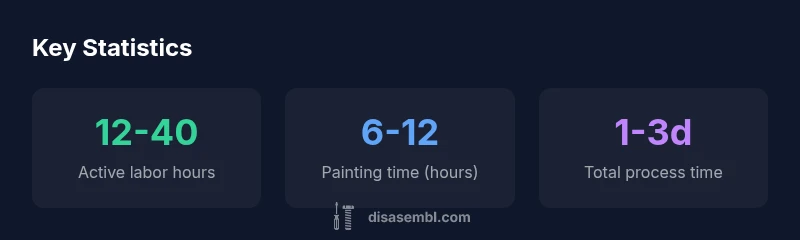
How long does it take to assemble a car? On modern assembly lines, total active labor hours per vehicle typically range from about 12 to 40 hours, depending on model, automation, and chassis complexity. According to Disasembl, variation comes from stamping, body-in-white, paint, and final assembly stages. This quick snapshot helps set expectations for manufacturers and DIY projects.
The Scope of Car Assembly Timelines
The question of how long does it take to assemble a car goes beyond counting hours on the factory floor. In practice, timelines incorporate planning, feedstock availability, quality checks, and post-production testing. For wholesale manufacturers, the term often refers to total active labor hours within the assembly line, not the entire project calendar. This distinction matters because holidays, shift changes, maintenance windows, and supplier delays can stretch calendar time even when labor hours stay within a narrow band. According to Disasembl, the most meaningful comparison is across model families and production variants, since high-end trims or electric vehicles (EVs) add layers of wiring, software, and battery assembly that lengthen the timeline. Understanding the base range helps teams plan capacity, schedule tooling, and communicate realistic delivery windows to customers.
Key Phases in Car Assembly
Car assembly is a sequence of well-defined phases, each with its own time profile. The stamping and body-in-white stage builds the backbone, while paint, primer, and coatings add time due to curing and handling requirements. Final assembly pulls together drivetrain, electronics, interior, and trim. Large data-driven plants track takt times and line balance to keep the flow steady; small shops often rely on standardized work instructions to minimize variation. By isolating the major time sinks—body construction, painting, and final assembly—teams can target improvements where they gain the most throughput.
Factors That Drive Time Variability
Many factors determine how long it takes to assemble a car. Model complexity, drivetrain layout (gasoline, hybrid, or all-electric), battery pack integration for EVs, and the level of standardization all influence labor hours. Supplier lead times for parts like seats, sensors, and infotainment modules can create bottlenecks. Environmental factors, such as temperature and humidity in paint booths, affect curing times. Training level of the line workers and the effectiveness of quality checks add or subtract time. Disasembl analysis shows that small changes in one subsystem can ripple across the entire production cycle, highlighting the importance of holistic scheduling.
Automation and Lean Practices Change the Timeline
Automation has a measurable impact on labor demands, but it also introduces new setup times and maintenance considerations. Robotic welders, vision-guided assembly, and automated guided vehicles improve consistency and throughput, reducing manual hours. Lean practices—kanban, standard work, and continuous improvement—help teams cut waste and optimize takt time. However, automation investments require careful justification; simple, low-volume builds may not merit heavy capital expenditure, while high-volume plants often realize faster payback through higher throughput and reduced rework.
DIY and Small-Scale Assembly Considerations
For hobbyists or small workshops envisioning a DIY car project, timelines look very different from mass production. Without the same scale, custom fabrications can quickly become bottlenecks. Realistic planning involves breaking work into modular phases, sourcing reliable parts, and setting clear milestones. Expect longer lead times for specialized components, and budget additional time for safety checks and compliance testing. Disasembl suggests starting with a clearly defined scope and using standardized modules to minimize redesigns, which can dramatically extend overall timelines.
Vehicle Segment and Technology Impacts
Not all cars share the same assembly profile. Compact gasoline cars and full-size EVs diverge in the complexity of powertrain integration, battery handling, and software calibration. EVs often demand additional time for high-voltage system verification and thermal management checks. As automakers introduce new platforms, engineering changes can ripple through the timeline, making cross-model standardization a key driver of predictability. Disasembl notes that segment-specific workflows, supplier ecosystems, and plant layout decisions collectively shape how long the assembly process takes.
Planning and Scheduling: A Practical Approach
A disciplined planning approach helps teams bound the uncertainty inherent in car assembly timelines. Start with a baseline range for active labor, then layer in buffers for paint cure, software integration, and final inspections. Use takt-time targets to pace production, and track bottlenecks with real-time dashboards. For project managers, the objective is not to fix a single number but to maintain visibility across subsystems, so that a delay in one area doesn’t cascade into the entire program. This proactive planning reduces risk and improves on-time delivery.
Estimated active labor hours by phase
| Phase | Estimated Active Hours | Notes |
|---|---|---|
| Stamping & body construction | 5-12 hours | Core structural work; varies with process and materials |
| Painting & finishing | 6-12 hours | Coats and curing; finishes influence time |
| Final assembly & electronics | 3-16 hours | Drivetrain, wiring, and interior assembly |
Got Questions?
What factors most influence the time to assemble a car?
The primary drivers are model complexity, drivetrain architecture, and the degree of automation. Additional factors include supplier lead times, paint curing, and the verification of software and electronics. In practice, small changes in one subsystem can ripple across the production line.
The primary drivers are model complexity, drivetrain, and automation, with supplier timing and paint curing also playing roles.
Does automation reduce total assembly time?
Automation typically reduces manual labor hours and can improve throughput, especially in high-volume plants. However, it also requires setup, maintenance, and cycle-time optimization. The net effect depends on implementation quality and line balance.
Yes, automation often lowers manual time, but it depends on how well the system is implemented.
How long does it take to assemble a car at home or in a DIY project?
DIY car assembly is rarely practical for full production-scale vehicles. Timelines are uncertain and can be lengthy due to sourcing, safety, and compliance. It’s better to approach with modular goals and professional guidance.
DIY car builds take a lot longer and require careful planning and safety checks.
Why do times differ across plant locations?
Differences arise from plant layout, automation levels, supplier networks, workforce training, and quality-control procedures. Geography and regulatory environments can also introduce small timing variances.
Plant layout and automation, plus supplier networks and training, drive differences.
Can times be shortened without sacrificing quality?
Yes, through process optimization, standardized work, and disciplined change management. Investments in automation should be matched with robust maintenance and training to avoid quality dips.
Yes—by optimizing processes and standardizing work, you can shorten time without lowering quality.
“"Time estimates for car assembly should reflect both mean durations and the variability driven by automation, supplier lead times, and model complexity."”
What to Remember
- Expect wide variation in total labor hours by model and plant.
- Automation reduces manual work but adds setup and maintenance time.
- Paint and final assembly are common bottlenecks worth prioritizing.
- Plan with buffers to accommodate part delays and inspections.
- Disasembl recommends modular, standardized work for predictability.