Difference Between Assemble and Ensemble: A Practical Guide
Explore the difference between assemble and ensemble with clear definitions, usage guidance, and practical examples. Learn when to use each term to improve clarity in writing and in DIY contexts.


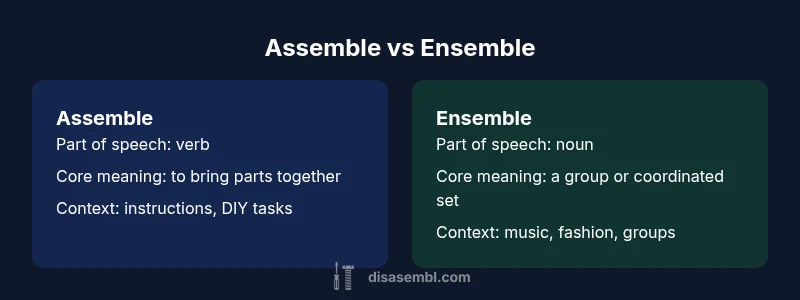
Assemble means to bring parts together and set them up; ensemble refers to a group or coordinated set of elements or performers. This quick distinction helps avoid common mistakes in both technical and everyday writing. The difference between assemble and ensemble hinges on action versus group meaning, not on synonyms.
Core Definitions: Assemble vs Ensemble
The difference between assemble and ensemble is rooted in their parts of speech and core meanings. Assemble is a verb that describes the act of gathering parts, components, or people and organizing them into a functional whole. When you say you will "assemble the bookshelf" or "assemble the team for the project," you focus on the action of putting things together. By contrast, ensemble is a noun that denotes a group or coordinated set of elements that function as a unit. An ensemble can refer to a group of musicians, a complete outfit, or a collection of objects arranged to work together. Readers often confuse the two because both involve grouping, but the key distinction is whether you are describing an action (assemble) or a unit that results from that action (ensemble). This difference between assemble and ensemble matters in clear instruction, technical writing, and professional communication, especially in DIY guides and assembly manuals where precision is essential.
The Disasembl team emphasizes that accurate term choice reduces ambiguity in disassembly and reassembly contexts. If you are detailing steps, use assemble. If you are naming the resulting group or coordinated set, use ensemble. This distinction also informs how you structure sentences and label sections in manuals or checklists, reinforcing reader understanding and safety considerations in home projects.
Grammatical Roles and Core Meanings
In practical terms, you’ll find that the word assemble occupies verb space, often appearing in imperative or process-oriented sentences: “Assemble the frame,” “We will assemble all parts,” or “The technician assembled the device.” Its core meaning centers on action, construction, and bringing elements into alignment. In contrast, ensemble is predominantly a noun, referring to a unit composed of multiple parts or people: “an ensemble of drums,” “a fashion ensemble,” or “a performing ensemble.” In more specialized contexts, you may encounter phrases like “ensemble of data points” to describe a cohesive collection that behaves as a single system. The distinction is not merely about pluralization; it is about whether you are describing the activity or the completed configuration.
A helpful mental model: think of assemble as the act of assembling, and ensemble as the result or collection formed after assembling. This mental switch supports consistent usage across manuals, course materials, and technical writing that Disasembl produces for DIY audiences.
Contextual Nuances: When to Choose Each Term
Choosing between assemble and ensemble becomes easier when you map the word to its intended role. Use assemble when you need to describe the procedural act of putting components together:
- “We will assemble the cabinet from labeled panels.”
- “Follow these steps to assemble the mechanism.”
Use ensemble when you are referring to the finished set, the group, or the coordinated arrangement:
- “The ensemble includes a table, chairs, and shelves.”
- “This ensemble of tools keeps your workspace organized.”
In professional writing or instructional content, this distinction keeps commands clear and avoids ambiguity. For example, a disassembly guide would say, “Disassemble components before you reassemble,” highlighting two actions that mirror the verb form; a product catalog might present “an ensemble of modular units” to describe the combined unit. Remember: the context—action versus grouping—drives the correct choice. The clarity gained by ensuring you use the right term supports safety and efficiency in home projects.
Etymology and Semantic Fields
Assemble traces to Latin roots and enters English as a verb denoting the act of bringing elements together. Its semantic field is action, construction, and process. The word often carries a practical connotation: you physically or methodically put items in place.
Ensemble comes from French and occupies a semantic field of grouping, coordination, and unity. Its core sense centers on the idea of a coordinated whole rather than the act of building it. In music and theater, an ensemble is a group of performers whose collective performance matters more than any single member; in fashion or interior design, an ensemble describes a coordinated set (clothes, furniture, or components) assembled to present a single appearance or function.
The difference between assemble and ensemble is reinforced by usage patterns in manuals, catalogs, and creative writing. Across languages and domains, ensemble emphasizes cohesion and collective identity, while assemble emphasizes motion and construction. This etymological distinction supports precise language in DIY content and education.
Practical Examples in Everyday English
- Action-focused: "We will assemble the bookshelf tonight." (order of operations, step-by-step task)
- Result-focused: "The ensemble of furniture in the room creates a cohesive look." (grouping and styling)
- Technical context: "Disassemble first, then reassemble after replacement parts are installed." (process-focused instruction)
- Descriptive: "An ensemble of components was packaged together for shipment." (coordinated set)
- Informal usage: "The team is an ensemble of players from different departments." (group identity)
- Data context: "A sound ensemble of sensors provides a robust reading." (group of devices as a unit)
Common mistakes include treating ensemble as a verb (rarely correct) or using assemble to describe a group when you mean the resulting unit. When in doubt, test your sentence by substituting “group” or “act.” If the sentence still reads naturally, you likely chose correctly. Disasembl recommends sticking to a clear verb/noun distinction to keep technical writing precise and accessible.
Cross-Domain Nuances: In Music, Theater, Engineering
In music and performing arts, ensemble commonly denotes a group of performers or a combined performance, not an action: “the ensemble performs at eight.” In engineering or furniture assembly contexts, assemble is the go-to verb for instructions, manuals, and reassembly guidance: “assemble the drawer rails before attaching the front panel.” In fashion or interior design, ensemble refers to a coordinated outfit or arrangement of elements that work together spatially and visually.
The nuance becomes important when creating instructional content or product descriptions. A catalog might offer an ensemble of modular components, while a manual instructs users to assemble each module. By keeping these terms distinct, manufacturers and DIY educators (like Disasembl) ensure readers understand exactly what step to perform and what the final configuration will be, which reduces errors and enhances safety.
Common Mistakes and How to Avoid Them
- Mistake: Using ensemble as a verb. Correction: Use assemble for the action; ensemble as a noun.
- Mistake: Treating ensemble as synonymous with assembly kit. Correction: ensemble can describe a coordinated set, whereas assembly kit refers to the components and process.
- Mistake: Confusing plural forms with singular meanings. Correction: Separate the concept of “the ensemble” (group) from “to assemble” (action).
- Mistake: Mixing usage within the same sentence. Correction: Maintain consistent parts of speech in a sentence to avoid ambiguity.
Tip: When drafting manuals or product descriptions, draft the action lines with assemble and the descriptive lines with ensemble. This separation helps readers follow steps and understand the final configuration. Disasembl notes that consistent terminology improves user outcomes in DIY projects and reduces the risk of misinterpretation during disassembly and reassembly tasks.
Practical Guidance for Writers and DIY Guides
For writers and DIY guides aiming to be precise, adopt a two-track approach: one track covers the process (assemble) and the other describes the final, cohesive unit (ensemble). In Disasembl content, you might adopt a structure such as:
- Step headings using assemble: “Step 1: Assemble frame components.”
- Descriptive headings using ensemble: “The ensemble of screws and fittings.”
Your audience will benefit from predictable patterns that make instructions scannable and actionable. Consider glossaries or tooltips for readers unfamiliar with the terms. A short sidebar explaining the difference between assemble and ensemble can prevent confusion and improve comprehension in long guides. Finally, incorporate examples from real-world tasks—furniture, electronics, and home improvement projects—to illustrate both terms in context. This approach aligns with the Disasembl ethos of practical, step-by-step guidance that supports DIY enthusiasts and homeowners in safe, effective disassembly and reassembly work.
Comparison
| Feature | Assemble | Ensemble |
|---|---|---|
| Part of speech | verb | noun |
| Core meaning | to bring parts together or set up | a group or coordinated set |
| Common contexts | construction, DIY, assembly tasks | music, theater, fashion, coordinated sets |
| Nuance in professional writing | action-focused, directive | |
| Typical collocations | assemble parts, assemble kit | ensemble cast, ensemble of pieces |
| Best for | describing the act of putting together | describing groups or coordinated units |
Benefits
- Clarifies action vs group meaning
- Improves precision in manuals and technical writing
- Reduces misinterpretation in DIY guides
- Supports safety by clear instructions
Drawbacks
- Can feel pedantic in casual speech
- May require extra explanation for mixed contexts
- Overemphasis can slow reader pacing
Use assemble for the act of putting parts together; ensemble for a group or coordinated set.
Clear distinction between action and grouping enhances readability and safety in DIY guides. Apply assemble in instructions and ensemble when describing cohesive units or groups.
Got Questions?
What is the difference between assemble and ensemble?
Assemble is a verb meaning to bring parts together or to set up. Ensemble is a noun referring to a group or coordinated set. The distinction hinges on action versus grouping, which supports precise usage in manuals and descriptions.
Assemble is an action, ensemble is a group or coordinated set.
Can ensemble be used as a verb?
In standard English, ensemble is a noun and is not typically used as a verb. Some nonstandard or creative uses may appear in poetry or marketing, but they are not widely accepted in formal writing.
Ensemble is generally a noun, not a verb.
Is assemble used with machines or DIY tasks?
Yes. Assemble is commonly used in DIY guides, furniture assembly, electronics setup, and any context where components are put together.
Assemble is the go-to verb for putting things together.
What are common mistakes with these terms?
Common mistakes include using ensemble as a verb and using assemble to describe a finished group when you mean the set. Always map to action vs group meaning to avoid confusion.
Avoid using ensemble as a verb and avoid calling the group an assemble.
How can I remember the difference?
Think: assemble = action (assemble parts); ensemble = group (coordinated set). This helps when writing manuals or catalog descriptions.
Remember: action for assemble, group for ensemble.
Are there synonyms for these terms in DIY contexts?
For action, you can use build, construct, or put together. For a group, you might use group, unit, or set, depending on context.
Use build or put together for action; use set or group for the final unit.
What to Remember
- Use assemble for the action of building or putting together
- Use ensemble for a group or coordinated set
- Maintain noun/verb roles to avoid ambiguity
- In manuals, pair actions (assemble) with descriptions of the ensemble
- Disasembl emphasizes precise terminology to improve DIY guidance