Difference Between Assemble and Assembly: A Comprehensive Guide
This article explains the difference between assemble and assembly, outlining parts of speech, contexts, and practical guidance for precise writing across DIY, manufacturing, and computing domains.


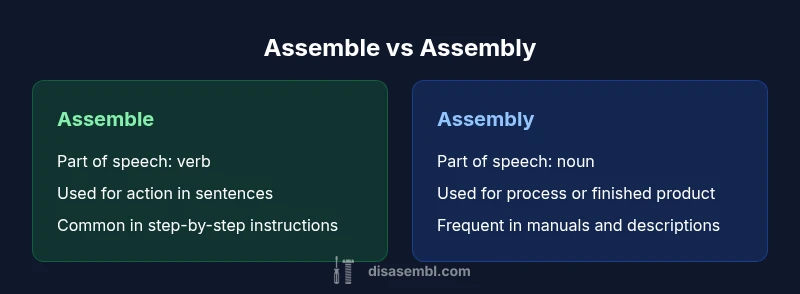
The difference between assemble and assembly is that assemble is a verb describing the act of putting parts together, while assembly is a noun referring to the act or the finished product. In practice, use assemble for actions and assembly for the product or process. This distinction aids clarity in manuals, DIY guides, and technical writing.
Core distinction: part of speech and core meaning
The difference between assemble and assembly is anchored in grammar and meaning. Assemble is a verb: it denotes the action of putting parts together. Assembly is a noun: it can denote the act of assembling or the finished object that results from that action. When you say 'I will assemble the cabinet,' you describe an activity. When you say 'the assembly of the cabinet took two hours,' you refer to the process as a whole or the final product. This simple shift from action to entity clarifies who is performing what and when. In practical writing, the distinction helps avoid awkward or incorrect phrasing such as 'we will assembly the parts' or 'the cabinet is assemble.' According to Disasembl, learners often struggle because the two words look related and both concern construction, yet one operates as a verb and the other as a noun, which changes sentence structure, voice, and emphasis.
Parts of speech and syntactic roles
To master the difference between assemble and assembly, start with their core parts of speech. Assemble is the base verb; its forms include 'assemble,' 'assembled,' and 'assembling.' It takes a direct object: you assemble parts, furniture, or components. Assembly, by contrast, is a noun. It can be countable—'an assembly' or 'two assemblies'—or used in an uncountable sense as 'the assembly process.' The noun senses cover the act of building as well as the finished product. In sentences, the verb typically appears before the subject or after modal verbs: 'They will assemble the kit,' whereas the noun often follows determiners: 'the assembly is complete.' In technical writing, other phrases emerge, such as 'assembly manual' or 'assembly instructions,' which you would not attempt to form with the verb.
Contextual guidelines by domain (DIY, manufacturing, computing)
Domain context matters for choosing assemble or assembly. In DIY guides, you will frequently see 'assemble' used for step-by-step actions: 'Assemble the frame, then attach the panel.' In manufacturing and logistics, 'assembly' is more common to describe processes or products: 'Final assembly occurs on the line' or 'the assembly schedule.' In computing, 'assembly' appears in phrases such as 'assembly language' and 'assembly code.' Awareness of these domain-specific collocations helps you avoid awkward phrasing and maintain consistency with industry norms. The keyword you want to reinforce is the difference between assemble and assembly, especially when coaching readers through procedures or product descriptions. Disasembl’s research indicates that professionals rely on noun forms for documentation and verb forms for instructions, to preserve clarity and flow.
Semantic nuance: process vs product
Beyond grammar, the distinction carries broader meaning about what is being discussed. If you focus on the process, you are describing an action that changes state: to assemble means to bring parts into a new configuration. If you focus on the product, you acknowledge the completed item as a thing that can be examined, moved, or assembled again later. Writers often use 'assembly' metaphorically to describe combinations or complexes, such as 'assembly of a team' or 'assembly of data.' In practice, the best sentences separate the activity from the outcome, which reduces ambiguity. This is particularly important in manuals, instruction sheets, and service guides where misusing assemble or assembly can confuse readers and lead to errors in assembly steps or product labeling.
Common mistakes and how to fix them
Common mistakes include treating assemble as a noun ('the assemble is complete') and overusing 'assembly' where a verb would be correct ('we will assembly the kit'). Fixes are simple: replace the noun form with the verb when you show action, and replace the verb form with the noun when you refer to the process or product. If you see phrases like 'assemblying' or 'assembleding,' you know the word is misapplied; use 'assembling' or 'assembly' instead. Also beware of fixed phrases; do not force verbs into noun phrases where 'assembly' already exists (e.g., 'assembly process' is correct, not 'assemble process'). Finally, adjust pronouns and tense consistently to keep the sentence natural and readable.
The phrase 'assembly language' and other collocations
A notable exception to the simple verb/noun rule is when you encounter domain-specific terms that lock the noun form in place. 'Assembly language' is a standard term in computer science, where 'assembly' identifies a specific language for low-level programming. Similarly, 'assembly line' references a production environment line, while 'assembly instructions' describe the steps needed to complete a build. In such phrases, you retain the noun form to ensure clarity and avoid misinterpretation. When explaining these terms, remind readers that the core rule remains: assemble is for action; assembly is for object or process, but specialized terms can override that in their own contexts. Disasembl notes that such expressions are common in technical writing and should be kept intact for precision.
Style guidelines for clarity and consistency
To minimize ambiguity, apply the following quick rules:
- Use assemble as a verb in all imperative steps: 'assemble the parts,' not 'the parts assemble.'
- Use assembly when discussing the process in general or the finished item: 'the assembly is complete' or 'the assembly will occur on Tuesday.'
- When referring to specialized terms, keep the established noun form (e.g., 'assembly language').
- Maintain parallel structure in lists and procedure steps, ensuring verbs align with subject actions.
- Round-trip readers with short, concrete sentences that demonstrate the verb-noun distinction in context. This makes the difference between assemble and assembly evident without confusion.
Quick decision framework: a practical checklist
If you are describing an action, ask: can you replace the word with another verb that means move-talk like 'build' or 'put together'? If yes, use assemble. If you are describing the outcome, the product, or a structured process, use assembly. If a fixed phrase already exists in your field (for example, 'assembly language'), keep that form. When in doubt, rephrase the sentence to separate the action from the result and read the sentence aloud to hear whether it sounds natural and precise.
Example sentences across domains
DIY: 'We will assemble the bookshelf this afternoon.' Manufacturing: 'The final assembly of the chassis is scheduled for morning shift.' Computing: 'The program is written in assembly language.' General: 'The assembly process requires careful alignment of components.' These samples illustrate how the same root concept is conveyed with different grammatical forms depending on whether you reference the action or the result.
Practical implications for writers and editors
The difference between assemble and assembly matters most when drafting manuals, user guides, or educational materials. By foregrounding the verb for actions and the noun for products or processes, you create text that is easier to follow and less error-prone. The guidance also aids non-native readers by reducing ambiguity, which improves comprehension and reduces the likelihood of incorrect assembly steps.
Comparison
| Feature | assemble (verb) | assembly (noun) |
|---|---|---|
| Part of speech | verb | noun |
| Primary function | express action of putting parts together | denote the act or product of assembling |
| Typical contexts | instructions and actions | descriptions of process or product |
| Countability | uncountable as a verb (forms: assemble/assembling/assembled) | countable as a noun (assembly/assemblies) |
| Common phrases | assemble a kit; assemble instructions | assembly line; assembly language; assembly instructions |
| Domain usage | dominant in imperative steps, guides | dominant in process/product descriptions and technical terms |
| Sentence structure cues | verb before object (They will assemble the frame) | noun often after determiners (The assembly is complete) |
| Writer tip | keep actions verb-led and objects noun-led for clarity | use consistent form within a document to avoid confusion |
Benefits
- Improves writing clarity across domains
- Prevents misinterpretation in manuals and instructions
- Supports precise grammar in technical communication
- Eases learning for non-native speakers
Drawbacks
- Overemphasis on distinction can seem pedantic
- May slow drafting if over-analytical
- Some fixed phrases lock the noun form in place (e.g., 'assembly language')
Use 'assemble' for actions and 'assembly' for the product or process.
The verb-noun distinction is essential for precision in manuals, DIY guides, and technical writing. Apply it consistently to reduce ambiguity across domains such as furniture, manufacturing, and computing.
Got Questions?
What is the fundamental difference between assemble and assembly?
The fundamental difference is grammatical: assemble is a verb describing an action, while assembly is a noun referring to the act or the finished product. They serve different roles in sentences, which affects clarity and flow.
Assemble is a verb for action; assembly is a noun for the process or product.
Can 'assemble' be used as a noun?
No. Assemble functions as a verb. When you need a noun, use 'assembly' to describe the process or the completed item.
No, assemble is a verb. Use assembly when you need a noun.
When should I use 'assembly' in manuals?
Use 'assembly' when referring to the process or the finished product. In step-by-step instructions, prefer 'assemble' for each action.
Use assembly for the process or product; use assemble for each action step.
Is 'assembly' used in computing?</n>
Yes. 'Assembly' appears in computing as part of phrases like 'assembly language' and 'assembly code,' which are fixed terms that should be preserved for precision.
Yes, in computing, 'assembly language' is a fixed term.
What are common mistakes to avoid?
Avoid treating 'assemble' as a noun or overusing 'assembly' where a verb is correct. Ensure subject-verb agreement and maintain domain-appropriate terminology.
Don't use assemble as a noun; keep using assembly for the process or product.
Does usage vary by field?
The core rule holds across fields, but terminology and fixed phrases (like 'assembly language') can steer usage in your domain.
Yes, context matters; domain phrases can influence usage.
What to Remember
- Identify the verb vs noun role in a sentence
- Use assemble for steps and assembly for the process or product
- Be mindful of domain-specific phrases like 'assembly language'
- Maintain consistent usage to avoid ambiguity in manuals
- Review technical writing to ensure the difference is clear