How to Use the Word Assemble: A Practical Guide
A detailed, example-rich guide on how to use the verb assemble correctly in English, with definitions, contexts, common errors, tense usage, and practical practice sentences.


You will learn how to use the verb assemble correctly in everyday English, including its primary meaning, common contexts, and typical collocations. The guide also covers tense and aspect, phrasal uses, and frequent errors to avoid, with clear example sentences to illustrate proper usage in both speech and writing. This makes the concept easy to apply in real situations.
Definition and core meaning
The verb assemble has two core senses that many learners encounter when they study how to use the word assemble. The primary sense is to bring or fit together parts to form a whole, as in a kit or furniture project: “We will assemble the bookshelf this weekend.” The secondary sense is to gather people or things into a group or system for a shared purpose, such as “to assemble a committee” or “to assemble the crew for a project.” In both uses, the idea is bringing pieces or people into a cohesive unit. In virtual or abstract contexts, you can still use assemble to mean “to bring together elements” (data, arguments, or ideas) to form a complete set or argument. Remember, the noun form is assembly, not assemble, which is the verb form. When learning how to use the word assemble, note that you often need a direct object (the thing being put together) and the sentence should clearly express what is coming together and for what purpose. This distinction helps avoid awkward or unclear phrasing and sets a solid foundation for natural usage.
Contexts where assemble fits
When you learn how to use the word assemble, you’ll notice it commonly appears in physical construction and organizational contexts. In DIY projects, it is standard to say, “assemble the cabinet,” “assemble the frame,” or “assemble the parts according to the diagram.” In organizational contexts, you’ll encounter phrases like “assemble a team,” “assemble a board,” or “assemble feedback from participants.” In technical writing, you might see sentences like “assemble components into a functioning prototype.” The common thread is deliberate combination, either of tangible parts or of people and ideas, to create a functioning whole. You’ll also see variants such as reassemble (to assemble again after disassembly) and disassemble (to take apart). Paying attention to what is being assembled and why it matters helps you choose the right wording and keeps sentences precise. As you practice how to use the word assemble, compare it with synonyms like combine, put together, or compile to understand subtle nuance differences.
Common errors and how to fix
A frequent mistake is treating assemble as interchangeable with gather or collect without considering the object’s nature. For example, you would typically say “assemble the furniture” rather than “assemble the data” if you mean a physical product, while you could say “assemble the committee” to mean organizing a group for a meeting. Another error is mixing up transitivity: assemble usually requires a direct object (the pieces or people) and sometimes a prepositional phrase to indicate where or how the assembly happens (e.g., “assemble into teams”). Finally, watch tense consistency. If you begin with a present-tense sentence like “We assemble the parts,” keep the tense consistent rather than switching to a different tense without purpose. When learning how to use the word assemble, practicing with concrete sentences helps identify these pitfalls and solidify correct usage.
Using assemble in different tenses and forms
The base form is assemble, with the simple past assembled and the present participle assembling. The past participle is assembled, used with have/has/had to describe completed actions: “They have assembled the kit.” The gerund/participle form is assembling, as in “We are assembling the pieces now.” The verb is typically transitive, taking a direct object (assemble the parts), but you may also see it used with subject-verb inversion for emphasis (“Only then did they assemble the crew”). A related noun form, assembly, denotes the act or result of putting parts together. When deciding how to use assemble, consider whether you need a physical assembly, an organizational assembly, or a figurative assembly, and match the tense to timing and aspect in your sentence.
Phrasal and extended uses
Beyond simple sentences, assemble appears in longer constructions that emphasize the process or the result. For example, “to assemble a product line” describes coordinating multiple components, while “to assemble evidence” means to collect information from sources to support a claim. You’ll also encounter the term reassemble, used when returning something to its previously disassembled state. In more conversational English, speakers might substitute with phrasal equivalents like “put together” or “bring together,” but assemble often carries a sense of deliberate construction or planning that adds formality or precision. Understanding these collocations and nuances helps you choose the right verb to convey the exact meaning you intend when teaching how to use the word assemble.
Style and register differences
Assemble tends to signal a purposeful, often procedural action. In home DIY contexts or product assembly instructions, it feels practical and precise. In casual conversation, you might hear “put together” instead of assemble for a lighter tone, but this changes nuance and formality. In technical or formal writing, assemble fits well with steps, protocols, and documentation. When you attempt to explain how to use the word assemble, favor clear, concrete objects, avoid vague references, and maintain consistent voice and tense. With practice, you’ll better judge whether a sentence needs the formal precision of assemble or a more relaxed synonym.
Practical examples across contexts
- Physical construction: “We will assemble the coffee table from flat-pack parts.”
- Organizational: “The committee will assemble evidence before the hearing.”
- Data or documentation: “They assembled the dataset from multiple sources.”
- Reassembly: “After the move, they reassembled the bookshelf in the living room.”
- Comparative: “Compared with ‘gather,’ assemble emphasizes deliberate construction or organization.”
These examples illustrate how to use the word assemble across contexts and help you practice how to use the word assemble accurately in sentences.
Conclusion and practice prompts
Practice makes perfect when learning how to use the word assemble. Create sentences that describe both physical construction and organizational tasks, paying attention to the object you assemble and the intent behind the act. As you study usage, compare sentences with similar verbs to identify subtle nuance. Keep a small list of reliable example sentences and gradually expand your own. Consistent practice will help you feel confident selecting the right verb in varied situations and with different audiences.
In-depth practice prompts
- Write five sentences using assemble to describe assembling a piece of furniture, a project plan, and a team.
- Create one sentence that uses assemble in the present perfect to describe a completed action.
- Draft a sentence showing how to reassemble something after disassembly, noting the difference from the initial assembly.
- Compare a sentence using assemble with one using gather; explain why assemble is the better choice in each case.
- Find two synonyms and two collocations for assemble, and write example sentences for each.
Tools & Materials
- English grammar reference(Print or digital; use it to confirm definitions and usage notes.)
- Dictionary or thesaurus (online or print)(Check precise meaning, collocations, and closely related verbs.)
- Notebook or writing app(Draft practice sentences and compare usage side-by-side.)
- Corpus or usage sources(Optional: consult real-world examples (e.g., online corpora).)
- Style guide or editing sheet(Helpful for checking tone, formality, and consistency.)
Steps
Estimated time: 45-60 minutes
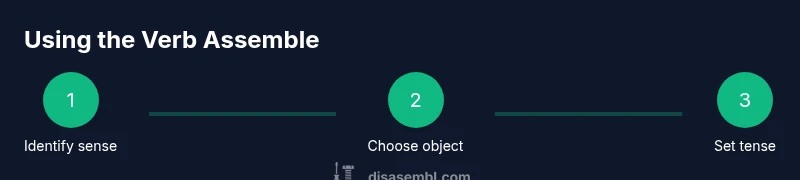
- 1
Identify the sense you need
Determine whether you are describing a physical construction or a figurative/organizational action. This will guide the object and context of your sentence.
Tip: If unsure, ask: Is the action about building something tangible or organizing people/things for a purpose? - 2
Check transitivity and object compatibility
Ensure you have a direct object that can be assembled (e.g., parts, a team, data). Avoid forcing an inanimate object that cannot realistically be assembled.
Tip: Ask: What is being assembled, and why is the assembly necessary? - 3
Choose the correct tense and aspect
Match tense to timing: present for ongoing actions, past for completed assemblies, present perfect for results or changes over time.
Tip: Keep parallel structure across clauses when you describe multiple steps. - 4
Construct clear, concrete sentences
Place the object immediately after assemble and add a brief context or purpose for clarity.
Tip: Prefer specific objects (e.g., ‘the cabinet parts’) over vague nouns. - 5
Compare with close synonyms
Differentiate assemble from put together, combine, or gather to ensure nuance is accurate.
Tip: Write two sentences with different verbs and explain why assemble fits better in one case. - 6
Check for naturalness and register
Assess formality: assemble often sounds precise and formal—adjust if your audience is casual.
Tip: If the tone is informal, consider ‘put together’ as an alternative. - 7
Practice with real-world contexts
Create sentences tied to DIY projects, teams, or data tasks to reinforce habit and fluency.
Tip: Review your sentences aloud to confirm natural rhythm and clarity.
Got Questions?
What are the main meanings of assemble?
As a verb, assemble primarily means to bring together parts to create a whole, or to gather people or things for a common purpose.
Assemble means to bring together parts or people for a common purpose.
Is assemble always transitive?
Most uses are transitive with a direct object, e.g., 'assemble the cabinet'; in some contexts it can be intransitive with adverbial phrases or with 'together'.
It's usually transitive with a direct object.
Can 'assemble' be used with abstract nouns?
Yes, in contexts like 'assemble a committee' or 'assemble evidence' where the object is not physical.
Yes, you can assemble abstract things like a committee or evidence.
What is the difference between 'assemble' and 'gather'?
Assemble stresses putting parts together or organizing a group with purpose; gather is broader, focusing on collecting items without implying assembly.
Assemble implies construction or deliberate organization; gather is broader and less precise.
Are there common collocations with assemble?
Common pairs include 'assemble a kit,' 'assemble furniture,' 'assemble a team,' and 'reassemble after disassembly'.
Common collocations include assemble a kit, assemble furniture, assemble a team, and reassemble after disassembly.
How do I practice using assemble in everyday writing?
Write sentences about small DIY projects or team planning, then compare with alternatives to pick the most precise verb.
Practice by drafting sentences about real tasks and comparing with synonyms.
Watch Video
What to Remember
- Understand assemble's core meaning: combine or gather.
- Use a direct object; monitor transitivity.
- Distinguish physical and conceptual uses.
- Practice with real sentences for accuracy.