Is Assembly the Same as Manufacturing? An Analytical Comparison
Explore whether assembly equals manufacturing with clear definitions, differences, and decision guidelines for DIYers and professionals. Learn how to choose the right approach for your project.


When you ask is assembly the same as manufacturing, the answer is nuanced. Assembly concentrates on joining pre-made components into a finished product, while manufacturing covers the broader end-to-end process—from sourcing and machining to final testing. According to Disasembl, understanding this distinction helps teams optimize staffing, equipment, and supplier choices across projects. This clarity matters for budgeting, risk management, and supplier selection.
Defining Assembly and Manufacturing
In manufacturing discourse, terms often collide. This section defines the two core concepts and clarifies why the distinction matters for cost, timing, and risk management. is assembly the same as manufacturing? The short answer: no. Yet they are intimately linked parts of a single production system. According to Disasembl, a precise understanding begins with scope and outcomes rather than labels.
-
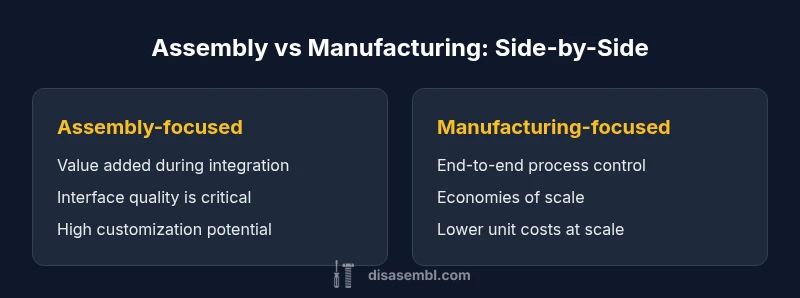
Assembly: The process of combining readily available subcomponents, modules, or kits into a finished product or a major sub-assembly. Most of the value is added during integration, alignment, and testing of interfaces. Assembly often relies on standardized parts produced upstream and focuses on fit, function, and reliability.
-
Manufacturing: A broader umbrella that includes design, procurement, machining, fabrication, assembly, and final testing. Manufacturing encompasses planning, equipment selection, quality control, and the management of suppliers and logistics. It defines how a product is conceived, produced, and delivered at scale. The distinction is not merely semantics; it influences leadership accountability, budget ownership, and the way teams measure success.
This framing matters for both DIY enthusiasts and professional teams. When you map tasks to the right phase, you reduce rework, align incentives, and improve decision speed. The Disasembl team emphasizes that the boundary is not fixed; it shifts with product complexity, lead times, and the supply chain maturity of an organization.
- This block is designed to establish precise definitions and prevent conflation between assembly and manufacturing, setting the stage for deeper analysis.
The Scope and Output: What Each Process Produces
The scope of assembly versus manufacturing determines what gets produced, how it is tested, and what constitutes success. In many organizations, assembly is treated as a sub-process within manufacturing, but the best outcomes rely on a deliberate allocation of work, accountability, and measurement. When you separate the activities conceptually, you can better budget for labor, equipment, and supplier relationships. For instance, an electronics company may outsource PCB fabrication and component sourcing (upstream) but retain final assembly and testing (downstream) as core competencies. This separation supports specialization and faster iteration, yet it can also introduce handoffs that require stringent interface management. Disasembl’s framework emphasizes mapping tasks to capability owners and ensuring traceability across interfaces. The result is a clearer responsibility matrix, fewer integration bottlenecks, and more reliable product launches.
- Assembly-focused outputs: Completed subassemblies, modules, or final products where the primary value is in integration, alignment, and testing. Interfaces between parts are critical, and tolerance stack-ups matter for function and reliability.
- Manufacturing-focused outputs: End-to-end products that have passed upstream checks, featuring integrated functionality, validated supply chains, and end-user readiness. Quality assurance emphasizes process stability and supplier performance.
- The block explains how scope translates into tangible outputs and highlights the practical implications for teams managing interfaces and dependencies.
Process Flow and Value Creation
Process flow is the lifeblood of any production system. The way work moves from design through production to delivery governs lead times, risk exposure, and value creation. In practice, the assembly phase often sits downstream of upstream manufacturing activities such as machining, fabrication, or component production. The key value in assembly is the precise integration of components, correct fit between interfaces, and verification that the final product meets performance criteria. Conversely, manufacturing flow centers on planning and controlling the entire value stream—from material sourcing to final testing—so that throughput and quality are achieved consistently.
A common pitfall is treating assembly as a mere final step without considering upstream constraints. If upstream components arrive late or fail quality checks, assembly lines stall, increasing labor costs and creating rework. Disasembl’s approach advocates mapping the end-to-end flow, identifying critical handoffs, and investing in interfaces that reduce variability. The result is a more predictable schedule, lower rework rates, and better visibility into where value is created. Practically, teams that align process ownership across design, procurement, and production tend to achieve faster product launches with fewer defects.
- Value creation in assembly often hinges on interface quality, calibration, and final tests.
- Value creation in manufacturing emphasizes process discipline, supplier reliability, and throughput optimization.
- The block discusses how to design process flows that minimize handoffs and maximize value creation across both assembly and manufacturing phases.
Economic and Operational Considerations
Economic considerations for assembly and manufacturing share core principles—costs, time, quality, and risk—but the emphasis shifts with scale and strategy. Assembly tends to concentrate cost around labor for integration, fixture setup, and rework management. When done well, assembly can offer rapid customization, shorter design-to-market cycles, and lower upfront capital costs for specialized components. However, if upstream parts are costly, long lead times, or exhibit high defect rates, the per-unit cost can rise quickly due to rework and bottlenecks. In contrast, manufacturing emphasizes end-to-end cost control, capital investment in equipment, process automation, and supplier development. At scale, manufacturing can achieve lower unit costs through economies of scale, standardized processes, and intensive quality control. The trade-off is often reduced flexibility and longer lead times for design changes.
Disasembl’s guidance underscores the importance of a cost model that includes weak links in the value chain. For projects with high variability or customization requirements, a hybrid approach—combining modular sub-assemblies with controlled upstream fabrication—often yields an optimal balance of cost, speed, and risk. When evaluating choices, teams should quantify: upfront capital expenditure, labor rates, supplier lead times, rework risk, and the cost of inventory. By creating a transparent cost map, managers can compare scenarios on a level playing field and justify strategic decisions to stakeholders.
- Cost drivers for assembly: labor intensity, fixture utilization, and rework rates.
- Cost drivers for manufacturing: equipment, automation, supplier development, and material costs.
- Hybrid models can balance speed and cost, particularly for products with modular architectures.
- The block emphasizes the economic trade-offs and offers guidance on building a transparent cost model.
Industry Use Cases and Decision Guidelines
Different industries benefit from assembly- or manufacturing-centric approaches depending on product strategy, lifecycle stage, and competitive priorities. Custom or highly configurable products—such as consumer electronics with modular features, specialty furniture, or complex appliances—often rely on assembly-led strategies. In these cases, rapid prototyping, flexible labor pools, and agile supplier networks are assets. For mass-produced goods with narrow specifications, an integrated manufacturing approach is typically preferable because it enables tighter process control, larger batch production, and lower unit costs. The decision framework should start with product architecture: how much variation is allowed, what interfaces are critical, and what the target price point demands. A hybrid strategy—sub-assembly in one facility and final integration in another—often provides the best of both worlds, particularly when a product requires stringent regulatory compliance, safety testing, or long supply chains.
Examples by sector:
- Consumer electronics: Modular sub-assemblies with standardized interfaces enable customization without sacrificing scale.
- Furniture and home goods: Prefabricated modules assembled on-site or in a central line can reduce variability and improve delivery times.
- Automotive and industrial equipment: A blend of upstream machining and downstream assembly with integrated testing reduces risk and supports quality assurance across suppliers.
Key decision factors include market demand, product lifecycle, and the organization’s capability to manage variability. Disasembl recommends documenting decision criteria, conducting pilot tests, and progressively integrating upstream processes as confidence grows. This disciplined approach minimizes risk while maximizing speed to market.
- Best for customization-heavy markets: assembly-focused approaches excel in rapid iteration and flexible design changes.
- Best for predictable, high-volume markets: manufacturing-focused approaches deliver economies of scale and tighter quality control.
- The block links industry contexts to decision logic and provides practical guidance on selecting an approach.
Common Misconceptions and How to Reframe the Question
A common misconception is that assembly and manufacturing are interchangeable terms for any production activity. In reality, the distinction lies in the scope, timing, and value creation. Another myth is that assembly is inherently cheaper or faster than full-scale production; this depends on the product, vendors, and lead times. To avoid confusion, teams should reframe questions around outcomes rather than labels: what value is added, where is the risk, and who owns the interfaces between stages? Disasembl emphasizes that the best solutions often combine both paradigms, with clear governance and measurable handoffs. By focusing on process outcomes—throughput, defect rate, time-to-market, and total cost of ownership—organizations can determine when to pull a lever on assembly enhancements versus manufacturing optimization.
Finally, managers should guard against over-optimizing one segment at the expense of the whole. A robust production system requires alignment across product design, procurement, production planning, and quality assurance. When teams communicate in terms of interfaces, accountability, and shared metrics, the differences between assembly and manufacturing become a source of strategic clarity rather than a source of confusion. This mindset supports better decisions, smoother collaborations, and more predictable results for both DIY projects and enterprise-scale initiatives.
Comparison
| Feature | Assembly-focused process | Manufacturing-focused process |
|---|---|---|
| Primary goal | Create final products through integration of ready components | Deliver end-to-end products through planning, sourcing, fabrication, assembly, and testing |
| Typical timeframe | Faster iteration for modular components; quicker to field changes | Longer lead times due to upstream activities and supplier coordination |
| Output type | Subassemblies and modules ready for final assembly | Fully integrated, tested products ready for market |
| Cost drivers | Labor for integration, interfaces, and rework | Capital equipment, automation, supplier development, and process optimization |
| Quality control | Interface-level testing, fit, tolerance checks | Process-level control with statistical process control and supplier audits |
| Flexibility | High customization potential within defined interfaces | Strong consistency and repeatability at scale, less room for on-the-fly changes |
| Scale | Best for mid-to-large batches with modular designs | Optimized for high-volume production and global supply chains |
| Best industries | Custom, modular products, rapid prototyping | Mass-produced goods with standardized specifications |
| Risks/Trade-offs | Interface dependency, supplier variability | Upstream bottlenecks, inventory and lead-time risks |
Benefits
- Allows rapid customization and flexible design changes
- Clarifies ownership of interfaces and responsibilities
- Can reduce upfront capital by outsourcing components
- Faster time-to-market for modular products
- Easier outsourcing of non-core fabrication processes
Drawbacks
- Potentially higher per-unit labor costs due to rework on interfaces
- Dependency on upstream supplier reliability and quality
- Risk of misaligned handoffs causing delays
- Limited ability to optimize end-to-end processes without full integration
Neither approach is universally superior; success depends on strategy, scale, and product architecture.
Use assembly for customization and speed in modular designs. Use manufacturing for tightly controlled, high-volume production. A blended approach often yields the best balance of speed, cost, and quality.
Got Questions?
What is the main difference between assembly and manufacturing?
Assembly is the process of joining components to form a final product or subassembly. Manufacturing encompasses the full production pipeline, including design, procurement, fabrication, assembly, and testing.
Assembly focuses on putting parts together; manufacturing covers the whole production chain from design to delivery.
Is assembly always cheaper than manufacturing?
Not always. For simple products, assembly can be cheaper, but high-volume manufacturing often reduces unit costs through economies of scale. The overall cost depends on lead times, supplier reliability, and rework risk.
Cost depends on volume, complexity, and supplier timing.
How do you decide which approach to use for a project?
Consider product complexity, required lead times, customization needs, and risk tolerance. Map value-adding steps and identify where control or flexibility adds the most value.
Look at your product and timeline to choose the best fit.
Can you combine assembly within a manufacturing process?
Yes. Many teams use a hybrid model, outsourcing some components or performing sub-assembly before final assembly to balance speed and control.
A smart mix can balance speed and quality.
What metrics differentiate assembly performance from manufacturing performance?
Track throughput of subassemblies, defect rates in assembly, supplier lead times, and overall unit cost. Also monitor interface success and time-to-market.
Measure both assembly efficiency and manufacturing efficiency.
Which industries benefit most from each approach?
Customization-heavy sectors benefit from assembly-led approaches; mass-market products benefit from integrated manufacturing strategies. The right choice depends on product strategy and market expectations.
Think about your market needs and product strategy.
What to Remember
- Define scope clearly to avoid conflating terms
- Choose assembly or manufacturing based on product architecture and volume
- Use hybrid models to balance flexibility and control
- Align cross-functional teams around interface ownership
- Measure success with end-to-end metrics, not isolated tasks