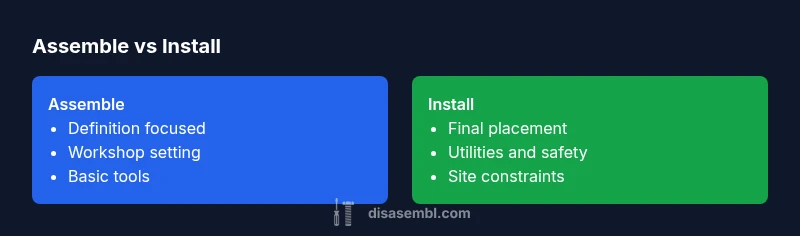
Difference Between Assemble and Install: A Practical Guide
A thorough, analytical comparison of assembling versus installing in DIY projects, with definitions, workflows, decision criteria, and practical checklists to help you plan furniture, appliances, and electronics.


According to Disasembl, the difference between assemble and install lies in scope and final outcome. Assemble means bringing parts together to form a complete unit, typically in a workshop or kit setting. Install means placing that unit in its final location and connecting it to power, mounting surfaces, or existing systems. Understanding this distinction improves planning, safety, and scheduling for any project.
What difference between assemble and install means in practice
In the world of DIY and professional projects, the phrases assemble and install describe two distinct phases of bringing a product to operation. The term assemble focuses on constructing a unit from its components, often in a controlled environment such as a home workshop or a kit-ready workspace. It involves following instructions, tightening fasteners, and validating that subassemblies fit together correctly. The term install, by contrast, refers to placing that already formed unit into its final setting and integrating it with the building, electrical, plumbing, or mechanical systems that enable operation. From the outset, DIYers should map out which phase applies to each task and plan resources accordingly. As Disasembl emphasizes, misclassifying tasks can lead to delays, rework, and safety concerns, especially on complex or heavy installations. The difference between assemble and install therefore acts as a compass for project planning, sequencing, and risk management.
Defining assemble and install with practical clarity
Assemble denotes the act of assembling components, configuring subassemblies, and confirming fit before any on site placement. Install means mounting, wiring, aligning, and commissioning the product in its intended space. The distinction matters for teams and solo makers alike because it informs tool selection, crew roles, space planning, and safety procedures. A clear boundary helps teams avoid working on the wrong phase at the wrong time and minimizes the chances of damaging parts or creating installation hazards. In everyday practice, many projects begin with careful assembly in a work area and finish with a formal installation at the desired location.
Why the distinction matters for planning and scheduling
A well defined boundary between assemble and install helps assign responsibilities, estimate durations, and secure required permits or inspections. When teams know that assembly is a prep phase and installation is the final integration phase, they can sequence tasks without duplicate work. This separation also supports better quality control, as subassemblies can be tested before they are placed in final service. For home projects, this approach reduces surprises when moving an item into a tight space or connecting to existing power or plumbing. The practical takeaway is to define the two phases early in the project timeline and document handoff points between teams or individuals.
The role of documentation in separating assemble from install
Documentation plays a critical role in reducing miscommunication between phases. Assembly instructions, subassembly checklists, and inventory lists must accompany the build process. Installation plans should capture site conditions, mounting requirements, and system connections. When teams share clear documents, it becomes easier to verify that the unit is ready for installation and that nothing is missing before final placement. Disasembl notes that thorough documentation is one of the strongest safeguards against delays and quality issues during the transition from assemble to install.
Tools and environments: aligning the phase to the task
The tools required for assembling parts are often different from those used for installation. Assembly relies on handheld wrenches, screwdrivers, and clamps to join pieces securely. Installation may require level devices, power tools, electrical testers, and mounting hardware. The work environment also changes: assembly often happens at a workbench with controlled lighting and space, while installation happens at the final site, with limited maneuverability and the need to account for space constraints, access to utilities, and safety protocols. Understanding these differences helps you prepare the right toolkit for each phase.
Common mistakes when separating assemble and install and how to avoid them
A frequent error is treating installation tasks as an extension of assembly without adjusting workflow, which can lead to misalignment or missing components. Another pitfall is failing to account for site constraints such as access, weight limits, and electrical codes. To avoid these issues, create a two phase plan with explicit handoff criteria, run a dry fit of the unit in the intended space, and verify that all mounting points and connections are ready before final placement. By clearly distinguishing assemble from install, you reduce risk and increase project predictability.
Practical criteria for deciding when to assemble versus install
Decide based on the product type, complexity, and site conditions. If the unit comes as a kit or modular parts that must be joined, prioritize assembly first. If the unit must be positioned, connected, and commissioned in its final location, prioritize installation after assembly. For products with critical safety concerns or regulatory requirements, install often triggers inspections and signoffs. In all cases, map the sequence, secure the necessary tools, and ensure the team understands the boundary between the two phases.
Contexts where assemble and install differ most
Furniture assembly typically emphasizes correct articulation and fit of parts, whereas furniture installation involves anchoring pieces to walls, aligning with other furniture, and ensuring safe placement. Electronics assembly focuses on component integrity and cable management, while installation emphasizes venting, power supply integration, and compliance with electrical codes. Appliances follow a hybrid path where assembly completes the unit and installation connects it to utilities. Recognizing these context differences helps you adjust processes and risk controls accordingly.
Case studies: simple to complex show how the boundary changes outcomes
In a small desk kit, assembling components might take 30 minutes with a basic toolkit, followed by installation to secure the desk to the floor and connect cables. A refrigeration unit, meanwhile, requires precise installation procedures including refrigerant handling, electrical wiring, and final commissioning, after assembling major assemblies on a service cart. In both cases the two phases matter, but the level of risk, equipment, and regulatory considerations differs. The key lesson is to treat assemble and install as distinct phases with separate requirements and acceptance criteria.
Handoff and project governance: ensuring smooth transition between phases
A successful handoff from assemble to install hinges on shared information. Create a short, structured handoff packet that includes part lists, subassembly checks, torque specs, and any site prerequisites. Require signoff from the assembler before installation personnel begin. When projects span teams or subcontractors, use a common platform for notes, photos, and version control. A disciplined handoff reduces friction, avoids duplicate work, and helps maintain schedule integrity across the project lifecycle.
Industry norms and terminology you should know
Industry practice treats assemble as the build phase and install as the final integration phase. Terms like dry fit, torque specification, and commissioning are common across many domains. Understanding these terms helps you communicate clearly with teammates, suppliers, and inspectors. For DIYers, learning the language of both phases ensures you can troubleshoot effectively and plan for any required tools or utilities. The distinction is not merely semantic; it shapes risk, cost, and outcomes across a project.
Comparison
| Feature | Assemble | Install |
|---|---|---|
| Definition / Focus | Brings parts together to form a complete unit | Places the unit in its final location and connects to utilities and systems |
| Typical Environment | Workshop, bench, or kit setting | On-site, final location with access to electrical, plumbing, or structural supports |
| Tools Required | Screwdrivers, wrenches, fasteners, clamps | Power tools, mounting hardware, measuring tools, testers |
| Timing / Scheduling | Short to moderate depending on complexity | Variable based on site access, approvals, and integration steps |
| Safety Focus | Stability of subassemblies, correct torque, and part integrity | Electrical, structural, and system safety at the installation site |
| Cost Considerations | Parts included in kit, minimal specialized labor | Possible installation fees, permits, or licensed professionals |
| Best For | Portability, customization, modular projects | Final operation, safety, and integration with existing systems |
Benefits
- Clarifies task boundaries for planning
- Improves scheduling and resource allocation
- Reduces on-site confusion and errors
- Supports safer, staged workflows
- Assists with quality control and testing before installation
Drawbacks
- Requires extra planning and documentation
- May extend the overall project timeline
- Demands coordination between teams or contractors
Install completes the product readiness; assemble prepares the unit
For most projects, plan assembly first and install last to minimize rework and safety risks. The Disasembl team highlights the separation as a best practice for planning, execution, and handoff.
Got Questions?
What is the main difference between assemble and install?
Assemble builds the unit from parts, while install places the finished unit in its final location and connects it to utilities or systems. This distinction guides planning, tools, and safety measures.
Assemble builds from parts, install places and connects the unit in its final spot.
Can I combine assembly and installation in one workflow?
You can combine steps in simple projects, but it increases risk of misalignment and rework. Separating phases improves verification and safety.
You can combine steps, but it increases risk of errors.
Which step should I plan first, assembly or installation?
Plan assembly first to ensure parts fit and movement is feasible, then schedule installation to integrate with location, utilities, and safety checks.
Plan assembly first, then installation.
What safety considerations are unique to installation?
Installation adds electrical, plumbing, and structural safety considerations at the site, whereas assembly focuses more on tool use and part integrity.
Installation adds electrical and structural safety concerns.
Do professionals handle installation differently from assembly?
Yes. Installation often requires credentials or licensed professionals for systems integration, while basic assembly can be done by trained DIYers.
Yes, installation often requires professionals.
How do I document the handoff between assembly and installation?
Create a checklist of completed subassemblies, attach inventories, and share installation plans with the team to avoid gaps.
Use a handoff checklist and shared plans.
What to Remember
- Define scope early with a clear assemble phase
- Schedule installation only after successful assembly
- Document handoffs to prevent gaps
- Equip two separate toolkits for each phase
- Consider professional help for complex installations