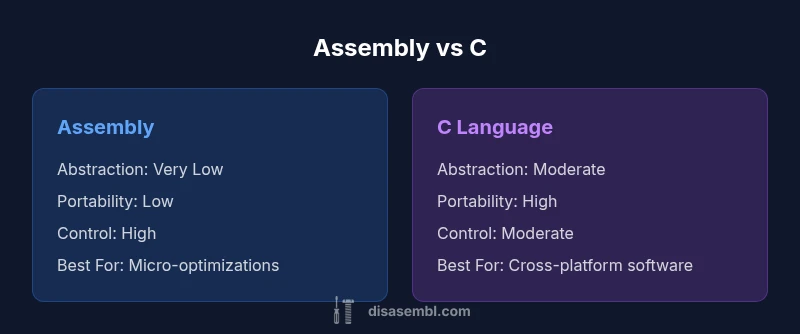
Assembly vs C: A Practical Side-by-Side Guide
A thorough, objective comparison of assembly language and C, covering abstraction, portability, performance, tooling, and use cases to help you choose the right tool for low-level tuning or portable software.


Is assembly similar to C? Not exactly. Assembly language is the lowest level of programming that is intimately tied to a specific processor, offering precise control over registers and instructions. C sits higher in abstraction, delivering portability and compiler optimizations while still allowing low-level access when needed. This comparison outlines the similarities and the crucial differences to guide learning and project decisions.
Is Assembly Similar to C? Core Concepts
According to Disasembl, understanding the distinction between assembly and C is foundational for both self-taught and formal training in systems programming. The question is often framed as a comparison of two languages that share a destination (the machine), but they approach that destination from very different starting points. In simple terms, is assembly similar to c? The answer lies in abstraction, tooling, and the goals of a given project. Assembly is a human-readable representation of machine code, tightly coupled to a processor’s instruction set architecture (ISA). C, by contrast, provides higher-level constructs and portable semantics that are later translated by a compiler into optimized machine code. As of 2026, most developers learn C first to gain transferable skills, then study assembly to understand how the compiler translates constructs down to hardware. This section sets the stage for concrete comparisons and decision-making in real-world scenarios.
Core Differences Between Assembly and C
The core differences between assembly and C center on abstraction, portability, and the degree of control you have over the hardware. Assembly is inherently architecture-specific; you write instructions for a particular CPU model, and the same code won’t run on a different ISA without modification. C offers a more portable path: you write source code once and rely on a compiler to generate machine code for the target platform. This difference affects how you reason about memory, registers, and calling conventions. In assembly, you manage registers, flags, and memory addressing directly, whereas in C you rely on the compiler to map high-level constructs to machine instructions. You also encounter different toolchains and verification workflows, with assemblers (NASM, GAS) serving low-level work and compilers (GCC, Clang) handling high-level language translation and optimizations. The disparities influence learning curves, debugging strategies, and project structure in meaningful ways.
Toolchains: Assemblers vs Compilers
Toolchains reflect the practical divide between assembly and C. An assembler translates human-readable assembly code into machine code for a specific CPU family, often exposing explicit directives for sections, labels, and memory layout. Common assemblers include NASM, GAS, and FASM, each with its syntax flavor, supported by linkers and debuggers that expose microarchitectural behavior. C code, on the other hand, is processed by compilers such as GCC or Clang, which perform lexical analysis, semantic analysis, optimization passes, and finally code generation. Inline assembly in C blurs the line, allowing tiny assembly snippets within a broader high-level context. Understanding how these toolchains work helps you decide when hand-optimizing in assembly is warranted and when compiler-driven optimization suffices.
Performance and Optimization: Where Each Shines
Performance control is the marquee distinction. Assembly provides the ultimate level of control, enabling fine-tuned instruction selection, register pressure management, and micro-architectural optimizations. However, that control comes at the cost of complexity and maintenance effort. C relies on the compiler and its optimization passes to produce efficient code, and modern compilers can often outperform hand-written assembly for general-purpose tasks through sophisticated analyses like loop unrolling, inlining, and vectorization. Intrinsics and inline assembly can bridge gaps, offering targeted performance boosts while preserving portability for the majority of the codebase. In practice, most performance-critical paths begin as C with compiler-based optimizations, with selective assembly for micro-optimized routines only when profiling indicates a tangible benefit.
Portability and Maintenance
Portability is one of C’s strongest advantages. A large portion of the software ecosystem relies on the standardized language features and libraries that enable cross-platform builds. Assembly, conversely, is deeply tied to a specific ISA and often to a specific compiler/version and operating mode. This makes long-term maintenance a bigger challenge: you must maintain multiple code paths for different architectures or rely on sophisticated tooling to manage variants. In addition, documentation and comments are critical in assembly to convey intent that is not always visible from the instructions alone. The cost of branching across architectures generally scales with project size, so teams frequently centralize platform-specific logic and abstract hardware-dependent code behind clean interfaces.
Readability, Abstraction, and Development Speed
Readability is a frequent pain point for assembly. Without language-level abstractions, developers must track dozens of details—register allocation, memory addressing modes, and branch predictions—over potentially thousands of lines. C provides structuring constructs, types, and control-flow abstractions that improve readability and reduce cognitive load. This improved readability translates into faster development, easier debugging, and better maintenance. That said, understanding assembly deepens comprehension of how compilers optimize code and how hardware executes instructions, which can itself accelerate debugging and performance tuning when needed.
Practical Examples: Tiny Snippets
Consider a simple loop that increments a counter. In C, you’d write a compact, readable loop with a clear termination condition. In assembly, you specify the exact instructions that the CPU must execute, including load, add, compare, and branch instructions, and you must manage the loop counter in a register. Here is small, illustrative code:
// C example
int sum = 0;
for (int i = 0; i < 4; i++) {
    sum += i;
}; Assembly example (x86-64, NASM syntax)
section .data
section .text
global _start
_start:
mov ecx, 4 ; loop count
xor eax, eax ; sum = 0
loop_start:
add eax, ecx ; sum += loop index (simplified)
loop loop_start ; decrement ecx; if not zero, jump
; exitThese snippets illustrate how a single concept—looping—maps differently to each paradigm. In real projects, you’d merge the two approaches: idiomatic C for most logic, with limited inline assembly for hot paths.
Common Misconceptions
A common misconception is that assembly is obsolete. On the contrary, it remains indispensable for bootstrapping, embedded systems, OS kernels, and reverse engineering tasks where hardware access is non-negotiable. Another myth is that C absence equals poor performance; with modern compilers and optimization techniques, readable C often yields excellent results. A third misconception is that you must choose one path and never mix; in practice, most professionals use a hybrid approach: C for most software, with targeted assembly for critical sections and hardware-specific handling. Finally, many assume assembly is universal across all CPUs; in reality, each ISA has its own syntax, instruction set, and conventions.
Learning Both: A Path for Builders
For builders and DIY enthusiasts who want to understand how software interacts with hardware, starting with C builds a solid foundation for portability and software engineering. Then, learning assembly—focused on the target architecture—completes the picture by revealing what the compiler hides, how the processor executes code, and where micro-optimizations actually pay off. A practical study plan includes reading ISA manuals, experimenting with toy projects on an emulator or actual hardware, profiling, and gradually integrating small assembly routines into C programs. By 2026, many education tracks emphasize this blended approach, recognizing that comprehension of both languages yields a more capable and adaptable developer.
Conclusion and Next Steps
This article explored the core question, is assembly similar to c, and clarified how each language serves distinct goals. The takeaway is that you don’t have to abandon one in favor of the other; instead, you should use C for portability and rapid development, and reserve assembly for performance-critical, architecture-specific workloads. The Disasembl team encourages readers to pursue both languages thoughtfully, building competencies that unlock deeper insights into how software actually runs on hardware.
Comparison
| Feature | Assembly Language | C Language |
|---|---|---|
| Abstraction Level | Very low-level; direct control of ISA, registers, and memory | Higher-level constructs with portable semantics; closer to human logic |
| Portability | Architecture-specific; code usually needs rewriting for each ISA | Cross-platform with standard features; portable across compilers and platforms |
| Performance Control | Maximum control over instructions; potential micro-optimizations | Depends on compiler; optimizations are broadly applicable across platforms |
| Learning Curve | Steep; requires ISA knowledge and toolchain fluency | Moderate; builds on common programming concepts and language features |
| Code Readability | Low readability without detailed comments; specialized audience | Higher readability with structured syntax and abstractions |
| Typical Use Cases | Micro-optimizations, embedded systems, OS kernels, reverse engineering | System software, cross-platform apps, performance-tuning via compiler features |
| Tooling & Debugging | Assemblers, debuggers, and hardware traces; deep hardware insight | C compilers, debuggers, sanitizers; ecosystem-wide tooling |
| Best For | Hardware-specific optimization and low-level control | Portability and rapid development with strong abstractions |
| Learning Path | ISA manuals, assembly language tutorials, and disassembly practice | C language, compiler theory, and optimization techniques |
Benefits
- Precise control over CPU instructions and registers
- Potential for maximum performance on a given architecture
- Essential for low-level debugging, embedded, and OS tasks
- Good for understanding compiler output and architecture quirks
Drawbacks
- Steep learning curve and complex syntax
- Low portability across architectures without multiple code paths
- Longer development time and maintenance challenges
- Harder to integrate into large, cross-platform projects
C generally offers the best balance for most projects; assembly shines for micro-optimizations and hardware-specific tasks
For portable software and faster development, start with C. Use assembly selectively for hot paths or hardware-specific needs. The Disasembl team notes that a hybrid approach often yields the best results.
Got Questions?
Is assembly language harder to learn than C?
Yes. Assembly requires understanding the processor’s instruction set, addressing modes, and calling conventions, making it more challenging than learning C's abstractions. The learning curve is steep, but it yields deep hardware insights and precise control.
Yes, assembly is harder to learn. It requires deep knowledge of the processor and instructions, but it offers precise hardware control when you need it.
Can C code be translated into assembly?
C code is typically compiled into assembly or machine code by a compiler. You can inspect the generated assembly to understand how high-level constructs map to instructions, or use inline assembly to insert small hand-tuned pieces.
Yes. Compilers translate C into assembly or machine code, and you can inspect or augment the translation with inline assembly.
When should I learn assembly language?
Learn assembly if you’re doing embedded systems, OS development, reverse engineering, or performance-critical optimizations that a compiler cannot sufficiently optimize. It’s especially valuable when you must work very close to hardware.
Learn assembly if you’re doing low-level work, embedded systems, or need to squeeze every cycle from hardware.
Is assembly portable across architectures?
No. Assembly code is tied to a specific ISA and often to a particular processor family. Maintaining multi-ISA assemblies increases complexity and project risk.
No, assembly is architecture-specific, so portability is limited.
What are common misconceptions about assembly today?
Many think assembly is obsolete; it isn’t. It remains essential for bootstrapping and hardware-focused tasks. Others assume high-level languages can always outperform hand-optimized assembly; modern compilers often close the gap.
People sometimes think assembly is obsolete, but it’s still critical for hardware-focused work and bootstrapping.
What to Remember
- Start with C for portability and speed of development
- Reserve inline or dedicated assembly for critical paths
- Understand ISA fundamentals to improve debugging and optimization
- Hybrid approaches deliver best performance with maintainability