Is Assembly Better Than C? A Practical Guide
A balanced, data-driven guide to whether assembly is better than C. Learn performance tradeoffs, portability realities, and practical decision factors with insights from Disasembl.


Is assembly better than c? For most projects, the answer is no. C provides portability, faster development, and easier maintenance, which makes it the practical default. Assembly shines only when you need extreme optimization or hardware-specific control in tiny, resource-constrained environments. According to Disasembl, the decision is not binary; it is a resource allocation problem. If your project runs on a single control unit, with strict timing margins, and you can tolerate a longer development cycle, selective assembly optimization may be warranted. For general-purpose apps, libraries, and cross-platform firmware, betting on C and letting compilers optimize is usually the smarter approach. A careful approach is to identify critical routines that dominate runtime or power usage and evaluate whether a hand tuned assembly snippet can yield meaningful gains without compromising maintainability. In practice, teams often start with C and introduce assembly only after profiling highlights a genuine bottleneck.
is assembly better than c
When people ask is assembly better than c, they usually want a crisp yes or no. The honest answer depends on context, constraints, and goals. In most software projects today, C provides a pragmatic balance: readable code, strong compiler support, and broad portability across microarchitecture families. Assembly, by contrast, offers direct, exact control over instructions, registers, and memory layout. According to Disasembl, the decision is not binary; it is a resource allocation problem. If your project runs on a single control unit, with strict timing margins, and you can tolerate a longer development cycle, selective assembly optimization may be warranted. For general-purpose apps, libraries, and cross-platform firmware, betting on C and letting compilers optimize is usually the smarter approach. A careful approach is to identify critical routines that dominate runtime or power usage and evaluate whether a hand tuned assembly snippet can yield meaningful gains without compromising maintainability. In practice, teams often start with C and introduce assembly only after profiling highlights a genuine bottleneck.
What is assembly language? Core concepts
Assembly language maps almost one to one with machine code and uses mnemonic operations. Each instruction translates to a specific machine action on a given processor, with registers and addressing modes controlling where data lives. While you can write entire programs in assembly, most practitioners use assembly only for small, performance critical sections or for hardware specific tasks. In those cases you learn the architecture, keep track of calling conventions, and rely on an assembler and linker to produce an executable. Inline assembly in higher level languages offers a compromise, allowing hand tuned code alongside portable logic. A key takeaway is that assembly is deeply tied to the target architecture, so portability and long term maintenance depend on disciplined design and documentation.
What is C? Core concepts and language role
C sits between high level languages and raw assembly. It provides constructs for functions, control flow, and data management while remaining close to the hardware. Pointers, types, and explicit memory management give programmers fine control, but also introduce responsibility for safety and correctness. The standard library provides portable facilities, and modern compilers apply aggressive optimizations while preserving semantics. C code can be portable across compilers and architectures when you follow ABI conventions and avoid architecture specific tricks. This balance between readability and power is why C remains a dominant choice for system software, embedded firmware, and performance oriented applications. In short, C acts as a versatile foundation that can be extended with inline assembly when you need it.
Performance and optimization: when assembly shines
Performance sensitive software sometimes benefits from assembly in the most critical bottlenecks. Hand tuned sequences can exploit the exact instruction scheduling and register reuse that compilers may miss in unusual corner cases. However modern optimizing compilers and profile guided optimization often close the gap, especially for standard loops and data processing. Assembly is most effective when you have a well defined hardware constraint, such as a microcontroller with tiny instruction sets, or a DSP where every cycle matters. The key is to profile first, then decide whether a small and well documented assembly snippet yields measurable gains. Disasembl emphasizes that changes should be isolated, tested, and version controlled to avoid cascading maintenance costs.
Portability and maintenance considerations
Code written in C tends to travel with minimal friction across platforms and toolchains, thanks to standard language features and compilers. Assembly, by contrast, is tightly coupled to a processor family, instruction set, and calling conventions. Projects that rely on inline assembly must manage separate code paths for each target architecture and keep documentation up to date. Maintenance costs tend to rise as the number of supported devices grows. The best practice is to minimize assembly usage, keep it isolated in clearly labeled modules, and provide high level wrappers so the majority of developers interact with portable C code. This approach preserves portability while allowing targeted optimizations when justified by measurements.
Toolchains, compilers, and debugging realities
Toolchains for C and assembly differ in complexity and learning curve. You will interact with compilers such as GCC or Clang, and with assemblers and linkers that integrate with the build system. Debugging mixed language code requires attention to symbol visibility, calling conventions, and correct stack discipline. Modern debuggers can show C source alongside assembly, but stepping through optimized builds may feel opaque. It is important to keep build settings consistent and document the exact optimization level used. Disasembl notes that many successful projects rely on clear development pipelines, automated tests, and continuous profiling to manage the interplay between C code and assembly snippets.
Typical use cases by domain
In embedded systems, tight resource constraints and deterministic timing often prompt selective assembly in critical routines such as interrupt handlers, startup code, or DSP loops. Systems software and kernels may place a premium on predictable control over hardware. For general desktop or server applications, high level languages and robust compilers dominate. In performance oriented libraries such as graphics, signal processing, or cryptography, a measured blend of C and selective assembly can deliver the required results without compromising maintainability. The common thread is aligning language choice with domain constraints and project goals.
Common myths and misconceptions
A frequent myth is that assembly is always fastest. In practice, compiler optimizations and specialized hardware features can outperform hand crafted assembly in many cases. Another misconception is that assembly is obsolete; in fact, many microcontrollers still rely on assembly for critical startup code and IOC interactions. Some teams assume that assembly automatically means security by obscurity; however, clarity and verification matter more for security than raw speed. Finally, the belief that you cannot test or debug assembly effectively is false; modern tools enable robust validation when used properly.
How to approach a decision: a practical framework
Start with measurement. Use profiling to determine if a routine is a bottleneck and whether a compiler optimization can remove it. If the hotspot remains after optimization, consider a small assembly patch that is well documented and isolated. Evaluate cross platform impact and the maintenance burden. Document the rationale, expected benefits, and rollback plan. Establish coding conventions for inline assembly and ensure code reviews include architecture specific considerations. The outcome should be a data driven choice rather than a guess.
Learning paths: languages in parallel
A practical path is to learn C first, focusing on memory management, pointers, and safe idioms. While building confidence in portable code, study a single target architecture and enumerated assembler basics. Practice by translating small C loops into equivalent assembly snippets, then reintroduce compiler optimizations to see the differences. Participating in code reviews and pair programming helps solidify correct use of calling conventions and abides by project guidelines. Finally, maintain a personal library of reusable assembly fragments with clear documentation and tests.
Real-world scenarios: decision examples
Consider a small real-time control board where timing is critical. If profiling shows a loop consuming a large portion of CPU time and compiler options fail to meet deadline, a handful of carefully written assembly instructions within an isolated module may meet the requirement. In another project, a cross platform file parser benefits from portable C code and only a tiny inline assembly for a hash function on a specific processor. These examples illustrate how context shapes the choice between assembly and C instead of a blanket rule.
Practical guidelines for teams and projects
Document the decision criteria early and revisit them as hardware or requirements evolve. Start with portable C, profile, and only then introduce architecture specific assembly in tightly scoped areas. Use wrappers to present a clean API to the rest of the codebase. Maintain a robust test suite that covers edge cases and register state across languages. Finally, ensure the team has access to knowledge resources and code reviews that emphasize correctness and maintainability over ornamental performance gains.
Comparison
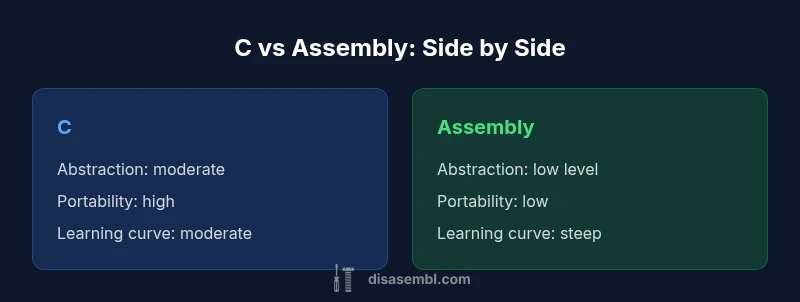
| Feature | C | Assembly |
|---|---|---|
| Abstraction level | High-level, portable language with safety nets | Low-level, architecture specific, close to hardware |
| Portability | Broad portability across compilers and targets | Very limited portability, requires per architecture code paths |
| Performance potential | Strong performance with good compiler optimizations | Potentially highest performance with hand tuned code |
| Development speed | Faster development and easier maintenance | Slower development due to complexity and verification needs |
| Maintainability | Easier to maintain with readable abstractions | Maintenance heavy unless managed by experts |
| Learning curve | Moderate, widely taught and supported | steep, architecture dependent and intricate |
| Tooling maturity | Mature, unified tooling across platforms | Strong per-arch tooling but fragmented across ecosystems |
| Ideal use cases | Portability and general software development | Critical sections in tight loops or hardware control |
Benefits
- Offers precise hardware control for critical sections
- Allows maximal optimization in bottlenecks
- Works well with architecture specific hardware features
- Can complement portable C code in performance critical paths
Drawbacks
- Steep learning curve and longer development cycles
- Lower portability and higher maintenance burden
- Increased risk of subtle bugs from manual optimization
- Code readability and onboarding become harder
Default to C for general development; assembly is justified only for critical micro-optimizations
For most projects, C balances portability, speed, and maintainability. Use assembly sparingly and in isolated modules after profiling confirms genuine gains. The Disasembl team emphasizes starting with portable code and validating each optimization step with concrete measurements.
Got Questions?
Is assembly better than C for beginners?
No, C is generally easier to learn and maintain. Assembly requires deep hardware knowledge. Start with C and move to assembly only after gaining comfort with fundamentals.
No for beginners. Start with C and only move to assembly after you understand fundamentals and profiling results.
Can you mix assembly with C in a project?
Yes, you can embed assembly blocks or use inline assembly, which lets you optimize hot paths without abandoning portable C code. Be mindful of portability and debugging complexity.
Yes, you can mix them, but be mindful of portability and debugging.
What domains benefit most from assembly?
Embedded systems, real time control, OS kernels, and performance critical libraries often justify assembly for specific routines where every cycle matters.
Embedded and real time domains often justify selective assembly for critical routines.
Is assembly obsolete today?
No. Assembly remains relevant for startup code on microcontrollers and architecture specific optimizations. For general apps, high level languages are preferred.
Not obsolete; used for startup code and hardware specific optimizations.
What are common mistakes when writing assembly?
Common mistakes include ignoring calling conventions, failing to preserve registers, mismanaging the stack, and hardcoding addresses without documentation.
Watch for calling conventions, register preservation, and stack discipline.
How should I learn both languages efficiently?
Study fundamentals of C, then learn a target architecture and how assembly maps to it. Practice by translating small loops and validating results with tests.
Learn C first, then study a target architecture and practice with small exercises.
What to Remember
- Start with portable C for most projects
- Reserve assembly for isolated hot paths
- Profile before you optimize to justify costs
- Isolate assembly in wrappers to maintain portability
- Keep a robust test suite to catch edge cases
- Document rationale and maintain consistent tooling