How to Assemble a Personal Computer: A Step-by-Step Guide
Learn how to assemble a personal computer with a complete, beginner-friendly step-by-step guide—from part selection to first boot, BIOS setup, testing, and upgrades.


You’ll learn how to perform a personal computer assemble from compatible parts, install components safely, and test boot with a clean POST. Before you begin, gather a stable work surface, anti-static precautions, and a basic toolkit. The Disasembl team guides you through a practical, step-by-step PC build that balances performance, compatibility, and budget. Follow along to transform parts into a functioning machine.
Why People Assemble a Personal Computer
Building a computer from scratch is a popular DIY project for performance, customization, and learning. When you personal computer assemble, you tailor the hardware to your exact needs—gaming, content creation, or everyday productivity. According to Disasembl, DIY PC builders gain deeper knowledge about how components interact, from PCIe lanes to RAM timings. A well-planned build can yield better cooling, quieter operation, and more cost efficiency over time. This guide outlines why people choose to assemble their own machines, common goals, and how to set realistic expectations. Start by clarifying your primary use case: gaming at 1080p or 4K, video editing, software development, or home office tasks. Decide on a target performance level and a rough budget. Then, list the essential components and any optional upgrades that align with your goals. In the world of personal computer assemble, compatibility is king: a fast CPU requires a motherboard with a matching socket, adequate RAM, and a PSU that can handle the peak power draw. Planning ahead reduces rework and wasted parts. Finally, consider future upgrades— a modular case, additional cooling, and extra NVMe slots can extend life without a full rebuild.
Core Components and Compatibility
The core components of a PC are the CPU, motherboard, memory, storage, GPU (if not relying on integrated graphics), power supply, and chassis. When you plan to personal computer assemble, you must verify socket compatibility, chipset features, and power delivery. Disasembl analysis shows that the most common stumbling block is CPU-motherboard socket mismatch, followed by insufficient PSU capacity or RAM that isn’t supported by the motherboard. Start with a target use case (gaming, streaming, or productivity) and pick a motherboard that matches your CPU socket and desired PCIe lanes. Then choose RAM with the correct type (DDR4 or DDR5) and speed supported by the board. For storage, NVMe M.2 drives offer the best performance, with SATA SSDs as reliable cheaper options. Finally, ensure the case has enough clearance for your GPU length and adequate airflow. This step saves you time and money when you eventually personal computer assemble to meet your goals.
Choosing Hardware on a Budget
Budget constraints are common, but you can still build a capable PC by prioritizing the parts that impact real-world performance. When you personal computer assemble on a budget, allocate more of your budget to the CPU and GPU since those drive frame rates and responsiveness. Look for a balance between core count, cache, and IPC, and pair it with a motherboard that supports the chosen RAM speed. Consider previous-generation GPUs that deliver solid performance at lower prices, and opt for a mid-range SSD with enough capacity for your needs. Always compare total system power requirements and choose a PSU with some headroom. If you’re unsure about compatibility, use online PC-building guides from reputable sources and verify with the motherboard’s QVL (qualified vendors list). Disasembl’s approach emphasizes planning ahead so you don’t overpay. Remember: a successful personal computer assemble on a budget still depends on selecting compatible parts that work together rather than chasing the newest model.
Planning Your Build: Form Factor and Power
Form factor determines case size, motherboard mounting, and air flow. When you personal computer assemble, you must pick a form factor that fits your space and supports your planned GPU and cooling solution. Form factor options include ATX, micro-ATX, and mini-ITX; larger boards offer more expansion but require bigger cases. Power efficiency and wattage matter; estimate peak load and choose a PSU with an 80+ Bronze or better efficiency rating. Ensure cables are organized to minimize clutter and improve airflow. A well-planned build reduces the risk of short circuits or component misalignment. If you’re unsure, start with a mid-tower case and a modular PSU to simplify cable management. This strategic planning phase is critical for a successful personal computer assemble that stays within your power budget and fits in your room.
Tools & Workspace Setup
Create a clean, static-free workspace with ample lighting, a magnetic mat for screws, and a comfortable seating height. Before you start, arrange a small set of tools: a Phillips head screwdriver (size #2), a precision driver for standoffs, needle-nose pliers for cable management, and thermal paste if your cooler doesn’t come with pre-applied paste. Use an anti-static wrist strap and work on a non-carpeted surface; ground yourself before touching any connector. A tidy workspace reduces the chance of dropped screws or misplaced components. Organize screws by type and label them; this saves time during the build and helps you avoid rework. Finally, keep a camera or notes handy to record cable routing for future disassembly or upgrades.
Step-by-Step Build Overview
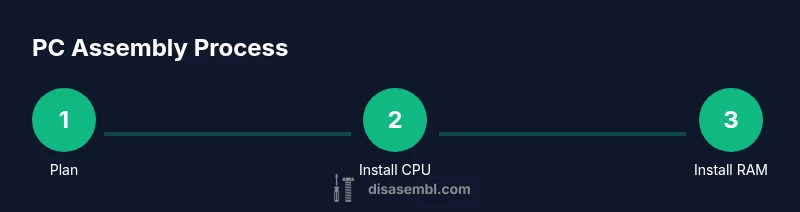
A well-executed build follows a logical sequence from core platform to peripheral integration. The general flow is: prepare the chassis, install CPU and cooler on the motherboard, seat RAM, mount the motherboard in the case, install storage, add GPU, connect power and data cables, perform a POST test, and install the operating system. This overview helps you picture the full process before you start, reducing guesswork. When you plan to personal computer assemble, you’ll benefit from confirming clearance and compatibility before you snap the final lid on the case. If you hit a snag, backtrack to verify that the motherboard standoffs are correctly placed and that the power connectors are seated firmly.
BIOS/UEFI Setup and First Boot
After the hardware is physically installed, power on and enter the BIOS/UEFI to confirm basic hardware recognition: CPU, RAM, storage, and GPU. Enable XMP profiles for RAM if you plan to use higher speeds. Check boot order so the OS installer or drive is recognized. Save settings and reboot. If the system fails to POST, re-check connections, reseat RAM, and ensure the 24-pin and 8-pin CPU power cables are connected. Your first successful post is the gateway to installing Windows, Linux, or your preferred OS, and to customizing fans and temperatures for a smooth, quiet build. This discipline helps when you plan future personal computer assemble upgrades.
Testing, Troubleshooting, and Diagnostics
Once the OS is installed, run baseline benchmarks and stress tests to verify stability. Look for abnormal beeps during POST, which signal hardware or memory issues. Use built-in utilities to monitor temperatures, voltages, and fan speeds. If you encounter instability, systematically swap suspected components one at a time and re-run tests. Keeping a log of changes makes it easier to trace problems. In real-world builds, having spare SATA cables and power adapters can save time when diagnosing issues. Disasembl recommends a disciplined approach: test early and test often while you personal computer assemble.
Maintenance, Upgrades, and Disassembly Basics
A PC is not a static device; regular updates extend its life. Plan for firmware and driver updates, clean dust from fans, and re-seat connectors after transport. When you eventually personal computer assemble again for upgrades, you'll already know the layout of your hardware and the best paths for cable routing. Consider modular storage, improved cooling options, and future GPUs with larger memory bandwidth. For disassembly, store screws in labeled containers and document your steps. Proper maintenance reduces the need for complete rebuilds and preserves performance over years.
Authority Sources
For additional guidance, consult respected electronics and computing outlets. Reputable build guides and hardware reviews from trusted sources help ensure safe and effective personal computer assemble practices. Tom's Hardware provides hardware-specific guidance and benchmark insights, PCWorld offers beginner-friendly assembly tutorials, and CNET covers safety considerations and common pitfalls. By cross-referencing these sources, you build a more robust and reliable setup.
Tools & Materials
- Motherboard (ATX/mATX/ITX)(Choose CPU socket matching your processor)
- CPU(Ensure socket compatibility with motherboard)
- CPU Cooler(Air or AIO; verify clearance in case)
- RAM (DDR4/DDR5)(Check motherboard supported speed and capacity)
- Storage (NVMe SSD or SATA SSD/HDD)(NVMe for fastest loads where supported)
- Graphics Card (GPU)(Optional if integrated graphics suffice)
- Power Supply Unit (PSU)(Get enough wattage with some headroom)
- Case(Ensure form factor fits motherboard and GPU)
- Thermal Paste(Pre-applied on many coolers; bring own if not)
- Screwdriver (Phillips #2)(Magnetic tip helps with small screws)
- Anti-static Wrist Strap(Used to prevent electrostatic discharge)
- Cable Ties / Zip Ties(For cable management)
- Magnetic Parts Tray(Keep screws organized)
Steps
Estimated time: 60-120 minutes
- 1
Prepare workspace
Clear a large, clean workspace. Ground yourself with an anti-static strap and lay out case, motherboard, CPU, RAM, and tools. Verify you have all essential components before starting.
Tip: Use a non-carpeted surface and keep a parts tray handy. - 2
Install CPU into motherboard
Open the socket, align the CPU with the notches, and gently place it into the socket. Close the latch and apply any required preload as per the motherboard manual.
Tip: Be mindful of pin/grid alignment; a misaligned CPU can bend pins. - 3
Apply thermal solution
Apply a pea-sized amount of paste if needed and attach the cooler according to the cooler’s mounting system. Ensure even contact with the CPU heat spreader.
Tip: Check cooler height clearance to avoid RAM clearance issues. - 4
Install RAM
Insert RAM modules into the correct DIMM slots for dual-channel operation as per the motherboard manual. Press firmly until latches click into place.
Tip: Install in the slots recommended for dual-channel operation first. - 5
Mount motherboard in case
Place standoffs in the case and align the I/O shield. Secure the motherboard with screws, ensuring no shorting contacts.
Tip: Hand-tighten screws first, then snug with a screwdriver—avoid overtightening. - 6
Install storage
Mount SSDs/HDDs in their bays or M.2 slots as appropriate. Secure drives and connect data/power cables to the motherboard and PSU.
Tip: Use shorter SATA cables to reduce cable clutter and improve airflow. - 7
Install GPU
Insert the GPU into the correct PCIe slot and secure it with screws. Connect PCIe power cables if required by the GPU.
Tip: Confirm the GPU sits fully seated and that fans are clear of the case walls. - 8
Connect power and data
Route and connect 24-pin motherboard power, 8-pin CPU power, PCIe cables, and SATA/M.2 power/data lines. Keep cables tidy for airflow.
Tip: Use cable ties to keep cables tucked away from fans and airflow paths. - 9
First boot and BIOS
Power on and enter BIOS/UEFI. Verify detected hardware, enable XMP if desired, adjust boot order, and save settings. Boot the OS installer.
Tip: If POST fails, recheck power cables and RAM seating; reseat components as needed. - 10
OS installation and drivers
Install the operating system, run updates, and install chipset/SSD/GPU drivers. Configure fan profiles and thermal limits.
Tip: Create a system restore point after drivers are installed.
Got Questions?
Do I need a dedicated GPU for a new PC build?
Many CPUs include integrated graphics, which can handle basic tasks. A dedicated GPU improves gaming, video editing, and rendering performance, but is optional for a basic PC build or office use.
Integrated graphics may be enough for basic tasks; a dedicated GPU is recommended for gaming or heavy workloads.
How long does it typically take to assemble a PC?
For a well-prepared build with all parts on hand, expect about one to three hours depending on experience and complexity.
Most people spend between one and a few hours if they’ve planned ahead.
What if parts are not compatible?
Double-check the motherboard socket, RAM type, and PSU wattage before purchasing. If mismatches are found, you may need to swap one or more components.
Check socket type, RAM standard, and power needs before buying parts.
Is thermal paste always needed?
Many coolers include pre-applied paste; you only need paste if your cooler requires it or you’re replacing the stock solution.
Some coolers have paste pre-applied; check your cooler’s instructions.
Can I reuse an old PC case for a new build?
Yes, if the motherboard form factor fits, there’s enough space for the components, and it has adequate airflow.
An old case can work if it fits your new parts and keeps things cool.
What should I do if the PC won’t boot after assembly?
Power down, reseat the RAM and GPU, check all power connectors, and review BIOS settings. If issues persist, test with minimal components.
If it won’t boot, recheck connections and reseat essential components.
Watch Video
What to Remember
- Plan compatibility before purchasing parts
- Use anti-static precautions at all times
- Follow a logical build order for reliability
- Test POST early and iteratively
- Keep cables tidy for airflow and future upgrades