Difference Between Manufacture and Assembly: An Analytical Guide
Explore the difference between manufacture and assembly with clear definitions, practical examples, and actionable guidance for DIY projects and manufacturing workflows.


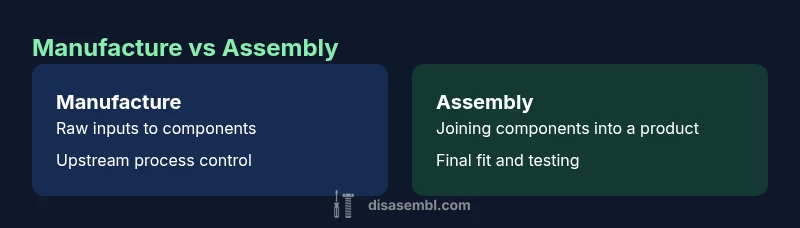
The difference between manufacture and assembly centers on what happens before and during production. Manufacture creates components from raw materials to form parts, while assembly combines those parts into a finished product. Understanding this distinction helps plan projects, source materials, and estimate lead times more accurately for DIY and manufacturing contexts.
What difference between manufacture and assembly means in practice
According to Disasembl, the distinction between manufacture and assembly is more than terminology; it's a lens for analyzing how products come to life. In practice, manufacturing refers to transformations of raw inputs into components or sub-assemblies through processes like casting, molding, machining, extrusion, or chemical synthesis. Assembly, by contrast, focuses on joining those components into a finished product, whether by fastening, welding, or module integration. The practical implication is that manufacturing decisions affect material choices, process capabilities, and upstream risk, while assembly decisions govern fit, system performance, and end-user experience. For DIY projects and professional production alike, recognizing where a task sits in the upstream-downstream sequence helps with planning, sourcing, and scheduling.
- Key questions to tag a task as manufacturing: Are you producing raw materials into parts, using specialized equipment, or aiming for scale and repeatability?
- Key questions to tag a task as assembly: Are you combining pre-made parts, ensuring correct fit and orientation, and validating final function?
- Example distinctions: Casting a metal bracket is a manufacturing step; attaching that bracket to a frame with screws is an assembly step.
Understanding the boundary between manufacture and assembly also informs cost modeling, quality control, and risk management. The Disasembl team emphasizes that early clarity reduces surprises during procurement and reduces rework later in the project.
Historical perspective on manufacture vs assembly
The terms manufacture and assembly evolved with the development of work organization. Early craft production prioritized bespoke, hand-finished parts—essentially a form of manufacture. As machinery, standardized components, and interchangeable parts entered manufacturing, the industry shifted toward bulk throughput. Assembly lines emerged as a way to rapidly combine pre-made components into final products, enabling scale without sacrificing functionality. This historical context matters today because many modern products sit on a spectrum between pure manufacture and pure assembly. Hybrid approaches blend material creation with module integration, supported by lean manufacturing principles that emphasize flow, quality at the source, and minimized handoffs. For DIYers and professionals, recognizing this continuum helps diagnose where delays occur and where improvements yield the largest gains.
Core characteristics that separate manufacture and assembly
- Process focus: Manufacture emphasizes creating components; assembly emphasizes combining those components into a complete product.
- Inputs vs outputs: Manufacturing starts from raw materials; assembly starts from pre-fabricated parts.
- Typical tasks: Manufacturing includes casting, forging, machining, and forming; assembly includes fastening, joining, wiring, and module integration.
- Lead times: Upstream manufacturing durations depend on tooling and capacity; assembly times depend on complexity and fit tolerances.
- Location and equipment: Manufacturing often uses dedicated tooling and controlled environments; assembly often occurs where components are staged or where the final product is completed.
- Quality control: Manufacturing tests material properties and component tolerances; assembly tests fit, alignment, and system-level performance.
- Best-for context: Manufacturing excels at scale and consistency; assembly excels at customization and final integration.
In practice, many products are designed with both stages in mind, and clear separation of responsibilities between manufacture and assembly can reduce risk, lower total cost, and improve time-to-market. For DIY projects, this distinction helps determine whether you source pre-fabricated parts or invest in making components from raw inputs.
Implications for DIY projects and home improvement
For the DIYer, recognizing the manufacture-assembly distinction improves planning and sourcing. If your project relies on pre-made components, you’re moving through assembly tasks that require precise fit and tolerances. If your project involves fabricating components from raw materials, you’re in the manufacturing realm and may need access to specialized tools, safety protocols, and quality control steps. When disassembling and reusing parts, understanding which phase each action belongs to helps estimate effort, tool requirements, and potential rework. This mindset supports better budgeting—allocation for material costs, tooling, and time—while reducing surprises during the build or rebuild. In Disasembl practice, separating these stages also clarifies risk: manufacturing-stage decisions influence material availability, while assembly-stage decisions influence successful integration and end-user satisfaction.
Case studies: simple examples
- Example 1: Wooden chair components. In this case, manufacture produces the chair legs, seat, and back panel from raw lumber or processed composites, shaping parts to consistent dimensions. Assembly then joins those parts using screws, dowels, or joinery to create the finished chair. The manufacturing phase sets tolerances and material choices; the assembly phase ensures stability and comfort, affecting final usability and aesthetics.
- Example 2: Flat-pack bookshelf. The manufacturer cuts and laminates panels, creates hardware, and packages the kit. The consumer or installer completes the product by assembling the panels with provided hardware, aligning edges, and performing a final check for plumb and level. These steps illustrate a clean boundary: manufacture provides standardized, interchangeable parts; assembly completes the product with a final configuration and fit.
Common misconceptions and pitfalls
- Misconception: All products are either fully manufactured or fully assembled. Reality: Most products sit on a spectrum, with varying degrees of upstream fabrication and downstream integration.
- Misconception: Assembly is less important than manufacturing. Reality: Poor assembly can ruin a well-manufactured component if fit, alignment, and safe operation are not guaranteed.
- Pitfalls: Neglecting tolerance stacking in assembly, underestimating lead times for sourcing specialized components, and ignoring post-assembly testing can lead to cost overruns and quality issues.
How to assess a project: a practical checklist
- Define the product’s core components and modules. 2) Identify which parts are feasible to manufacture in-house and which should be sourced as pre-fabricated components. 3) Map the sequence: downstream assembly should align with upstream manufacturing capabilities. 4) Estimate lead times for tooling, material procurement, and sub-assembly production. 5) Plan quality checks: material specs for manufacturing and fit testing for assembly. 6) Build a risk log focusing on supply chain fluctuations and change control. 7) Create a modular plan to interchange components if needed. 8) Include testing phases for both component quality and final product performance.
Quality, cost, and time considerations across both stages
Quality in manufacture centers on material consistency and process control, while quality in assembly centers on fit, alignment, and system integrity. Cost drivers in manufacturing include raw material costs, tooling, energy, and efficiency, while assembly costs hinge on labor time, tooling for fastening or joining, and tolerance management. Time considerations differ: upstream manufacturing can be resource-intensive and schedule-driven, whereas assembly time depends on assembly complexity and the number of joints or interfaces. For DIY projects, a modular approach—where possible—helps you stage work by separating manufacturing-like activities (rough cutting or forming) from assembly-like activities (final fit and fastening). Efficiency gains come from standardizing parts, reusing modules, and refining assembly sequences to minimize handling and rework.
The Disasembl perspective emphasizes that distinguishing these stages enables better planning, safer work practices, and more predictable outcomes in both home projects and professional settings.
Authority sources and practical takeaways
- In manufacturing and assembly, process boundaries matter for planning and execution. Notable sources include government and educational references that discuss manufacturing processes, product design, and system integration. https://www.bls.gov/
- Academic and policy discussions on manufacturing and standardization also appear in major publications and university sites. https://www.mit.edu/
- For broader industry perspectives on efficiency and operations management, reputable business publications provide insights on process optimization. https://hbr.org/
In summary, understanding the difference between manufacture and assembly helps you plan more accurately, optimize sourcing, and improve product quality. The key is to map every task to a stage, manage risk at the boundary, and apply modular design where possible to simplify both manufacturing and assembly tasks.
Authority sources
Comparison
| Feature | Manufacture | Assembly |
|---|---|---|
| Definition | Creating components from raw materials into usable parts | Joining components into a finished product |
| Inputs | Raw materials, feedstock, semi-finished materials | Pre-fabricated components or modules |
| Typical tasks | Casting, forging, machining, forming | Joining, fastening, wiring, mounting |
| Outputs | Semi-finished parts, sub-assemblies | Finished product or system |
| Cost drivers | Material costs, tooling, energy, scale | Labor time, tolerances, assembly fixtures |
| Lead time factors | Tooling setup, capacity, batch production | Fit precision, alignment checks, packaging |
| Quality control focus | Material specs, process consistency | System integration and usability testing |
| Best for | High-volume, consistent parts production | Final product integration and customization |
Benefits
- Clarifies responsibilities and risk at each stage
- Enables better sourcing and inventory planning
- Supports scalable production and modular design
- Improves quality control at both component and system levels
- Facilitates cost estimation and scheduling
Drawbacks
- Requires cross-functional coordination and clear handoffs
- Misalignment can cause delays and rework
- Heavy upfront planning may slow early prototyping
Clear separation of manufacture and assembly yields better planning and outcomes
Manufacture shapes components; assembly shapes the finished product. Treating them as distinct stages improves sourcing, timing, and quality, while supporting modular, scalable workflows.
Got Questions?
What is the difference between manufacture and assembly?
Manufacture creates components from raw materials; assembly uses those parts to form the final product. The boundary helps plan costs, timing, and risk.
Manufacture makes the parts; assembly puts them together to make the final product.
Why does this distinction matter for DIY projects?
Knowing where a task sits helps you source materials efficiently, estimate lead times, and decide whether to fabricate parts or buy pre-made modules.
It helps plan material sourcing and timing for DIY builds.
Can a product be both manufactured and assembled?
Yes. Most products involve upstream manufacturing of components and downstream assembly for final integration. The boundary can shift with design choices.
Products usually need both stages; the line between them depends on how they’re designed.
Is manufacturing the same as fabrication?
Fabrication is often used interchangeably with manufacturing, but in some contexts fabrication emphasizes forming parts rather than system-level processes. The distinction is nuanced.
Fabrication focuses on making parts; manufacturing can cover broader processes.
How do I apply this in home projects?
Map your project to stages, source components thoughtfully, and design for modularity so you can swap parts if needed.
Plan in stages and use modular parts when possible.
What signals indicate assembly emphasis is needed?
If the main challenge is fit, alignment, or final integration, emphasize assembly planning, fixtures, and final testing.
Look for fit and alignment challenges to shift focus to assembly.
What to Remember
- Define stage boundaries early in a project
- Plan sourcing around manufacturing needs
- Budget time for both component creation and final assembly
- Coordinate teams to reduce handoff delays
- Use modular design to simplify both stages