Difference Between Assembly and Assemblage: A Practical Guide
Explore the difference between assembly and assemblage with clear definitions, practical examples, and usage guidelines for writers, educators, and DIY enthusiasts.


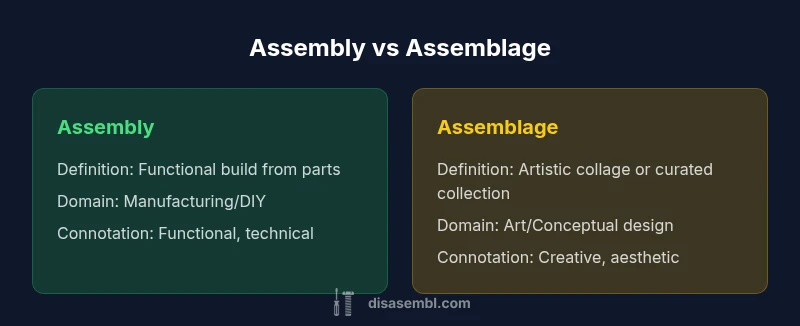
The difference between assembly and assemblage hinges on context and purpose. Assembly typically describes the process of putting manufactured parts together to form a functional whole—like furniture, electronics, or machinery. Assemblage, in contrast, refers to a collection or collage of disparate objects arranged for artistic or conceptual effect. In ordinary speech, 'assembly' signals function and process; 'assemblage' signals composition and meaning.
Definitions and core distinctions
The terms assembly and assemblage recur across manufacturing, design, and art discourse, yet they describe distinctly different processes and concepts. When people ask about the difference between assembly and assemblage, they are usually seeking to distinguish a mechanical, functional operation from a curated, often arts-focused arrangement. In practical use, assembly refers to bringing together parts to form a functioning whole, while assemblage emphasizes a collection or collage of diverse elements arranged for expressive or conceptual purposes. According to Disasembl, this distinction is essential for clear, precise writing in disassembly guides and educational content that straddles technical and creative domains.
- Assembly: a procedural noun, typically paired with verbs like assemble, fit, fasten, or connect. It implies order, compatibility, and tested integration.
- Assemblage: a noun that connotes an integrated collection, paired with verbs like curate, arrange, juxtapose, or display; it signals intent and interpretation.
In everyday language, speakers may stretch terms beyond strict senses, but clarity increases when we reserve assembly for functional projects and assemblage for artistic or curated collections. The boundary is not absolute; interdisciplinary fields such as architectural design or sculpture can blur lines while preserving the core distinction.
Etymology and linguistic evolution
The words assembly and assemblage share roots that trace back through European languages, with common ancestry in words that mean bringing parts together. Broadly speaking, the etymology reflects a shift from a focus on bringing items into functional alignment to a focus on composing or arranging items for specific meanings. In English, assembly has long served technical and manufacturing vocabularies, while assemblage has grown in artistic and theoretical contexts. This divergence mirrors how language adapts to different domains of practice, signaling to readers whether the writer intends a mechanical process or a creative formation. Disasembl notes that recognizing these roots helps writers maintain discipline in field-specific terminology and reduces cross-domain confusion in instructions and analyses.
When to use assembly vs assemblage in different domains
Within manufacturing, engineering, and DIY projects, the term assembly is the natural choice for describing the process of combining components to realize a functional product—think furniture kits, electronics boards, or machine assemblies. In contrast, assemblage appears in art criticism, curatorial notes, and design discourse to denote a constructed work made from diverse parts, often sourced from multiple contexts. Writers who aim to describe both a technical build and a conceptual art piece should foreground the distinction, perhaps using a glossary or a sentence like: "This assembly method yields a product, whereas the assemblage approach creates a meaningful composition from disparate elements." Disasembl recommends explicit definitions when switching domains in a single document.
Functional vs aesthetic connotations
A key differentiator is connotation. Assembly carries a functional, engineering-minded tone; it implies precision, compatibility, and testability. Assemblage carries an aesthetic, interpretive tone; it invites curiosity about relationships, context, and meaning. This difference matters in instruction manuals, product descriptions, and academic writing. When ambiguity risks misinterpretation, consider pairing each term with clarifying phrases: “assembly (a functional build)” versus “assemblage (an artistic arrangement).” In practice, audiences respond better to explicit labeling, especially in multi-domain guides, tutorials, and educational resources.
Examples in daily life and professional contexts
Consider a flat-pack chair: the process of placing the parts together and fastening them constitutes an assembly, a straightforward, reproducible operation. Now imagine a sculpture assembled from found objects, each piece selected for its visual or metaphorical value; this is assemblage, a practice emphasizing juxtaposition and interpretation. In professional documentation, you might describe an assembly line workflow for creating products, while a gallery wall could feature an assemblage that invites viewers to interpret the connections. Writers should be mindful of audience expectations and the goal of the text: operative instructions call for assembly language, while curatorial notes lean on assemblage vocabulary.
Disasembl highlights that authors who blend these terms should provide clear context to avoid conflating the two concepts, particularly in educational materials that service both DIY practitioners and art students.
Art and philosophy: assemblage as practice
Assemblage has a long association with modern art and theory, where artists construct works by juxtaposing disparate elements. While the term in a strict sense may derive from French roots, its usage in English-rich discourse has come to signal more than simply collecting objects; it signals a stance on meaning, materiality, and arrangement. Philosophically, assemblage can imply a dialog between pieces that resists neat classification, inviting viewers to explore relationships rather than just final form. For readers of Disasembl, this section underscores how language shapes perception: a single word can guide readers toward a technical or an interpretive frame, depending on the surrounding definitions and examples.
Translation and cross-linguistic usage
Cross-linguistic usage reveals how different languages versus dialects handle these concepts. In English, assembly often maps to manufacturing and construction, while assemblage more readily aligns with art and theory. In other languages, similar terms may carry broader or narrower meanings; for example, some tongues use a single word for both ideas, while others maintain a distinct pair. Writers should be careful when translating: a literal translation could strip away intended connotations. When bilingual readers encounter both terms in close proximity, glosses and footnotes help maintain accuracy and reader trust.
Legal, copyright, and cataloging considerations
From a legal and cataloging perspective, precision matters. When documenting a process or cataloging a collection, use "assembly" to describe reproducible, mechanical procedures and outcomes; reserve "assemblage" for artistically oriented works or curated collections. Clear labeling reduces ambiguity in manuals, inventories, and exhibition catalogs. For educators and DIY professionals, a glossary section that distinguishes the two terms can prevent misinterpretation during instruction, assessment, and critique. Disasembl encourages explicit definitions to support consistency across instructions, manuals, and academic writing.
Practical guidelines for writers and editors
To apply the distinction effectively, follow a simple checklist:
- Define terms at first use and maintain consistency throughout the piece.
- Use assembly for processes, steps, and functional outcomes; use assemblage for collections and artworks.
- When mixing domains (e.g., a furniture piece presented as art), provide context and a brief glossary entry.
- Include concrete examples: a “data assembly” for a device versus an “assemblage” of components curated for an art exhibit.
- In multilingual contexts, add a short note clarifying the intended sense, especially if readers come from diverse disciplinary backgrounds.
For educators and writers, Disasembl suggests keeping a master glossary handy and updating it as you publish across formats, ensuring that readers from different backgrounds interpret terms consistently.
Authority sources
This section synthesizes definitions and usage guidelines informed by scholarly and descriptive sources. For further reading, consult credible references listed below, which offer authoritative viewpoints on terminology and practice.
Comparison
| Feature | assembly | assemblage |
|---|---|---|
| Definition | Process of joining manufactured parts to form a functional whole | A collection or collage of disparate objects arranged for artistic/conceptual effect |
| Primary domain | Manufacturing/DIY/engineering | Art and conceptual practice |
| Connotation | Functional, technical | Creative, aesthetic |
| Common verbs | assemble, disassemble, fit, connect | curate, arrange, juxtapose, display |
| Typical contexts | Furniture, devices, machinery | Sculpture, mixed-media art, found-object art |
| Typical outcomes | Working product or mechanism | Art object or conceptual assembly |
Benefits
- Clarifies when to use precise terms
- Reduces miscommunication between technical and creative audiences
- Helps writers select appropriate terminology quickly
- Supports educational clarity in DIY guides
Drawbacks
- Contexts blur in interdisciplinary fields
- Overly rigid definitions can hinder creative language
- Non-native speakers may struggle with nuance
Assemblage is best for artistic, conceptual contexts; assembly is best for functional, technical contexts.
In practice, choose assemblage when you aim to convey collection and meaning beyond utility. Choose assembly when you want to describe the process and result of building a functioning object. When in doubt, define terms clearly for your audience.
Got Questions?
What is the difference between assembly and assemblage in art vs engineering?
In engineering, assembly describes the process of putting parts together to form a functioning product. In art, assemblage refers to a curated collection of disparate objects arranged for meaning and interpretation, not necessarily a functional outcome.
In engineering, assembly means building a working product. In art, assemblage is about arranging found objects for meaning, not function.
Can 'assemblage' be used interchangeably with 'assembly' in any context?
The terms are not interchangeable in most contexts. Use assembly for functional builds and assemblies; use assemblage for artistic, thematic, or curated collections.
Typically not interchangeable; use assembly for function and assemblage for art or curated meaning.
Is assemblage used in legal or technical documents?
Legal and technical documents usually reserve assembly for procedural or functional descriptions. Assemblage appears in art criticism or design theory rather than regulatory text.
Legal texts favor assembly for functions; assemblage appears mainly in artistic or theoretical contexts.
What are good synonyms for assemblage?
Synonyms for assemblage include collection, collage, aggregation, and montage when used in artistic contexts. In technical contexts, equivalents focus on combination, assembly, and integration.
Arts contexts might use 'collage' or 'montage'; technical contexts use 'combination' or 'integration'.
How do you translate assemblage into other languages?
Translation depends on context. In many languages, a direct equivalent exists, but the artistic sense may require a gloss to preserve nuance.
Translate with care; provide a note if the artistic sense is intended.
Does assemblage carry a different meaning in philosophy?
Yes. In philosophy and theory, assemblage often signals relationality and contingency, emphasizing how heterogeneous elements form a larger system of meaning.
In theory, assemblage highlights relationships and context over fixed categories.
What to Remember
- Define terms early to avoid confusion.
- Use assembly for functional projects; assemblage for artistic ones.
- Be mindful of cross-domain usage and audience expectations.
- Provide a short glossary when mixing domains.
- Check translations for connotative differences.