Difference Between Repair and Rework: Definitions, Processes, and Decision Criteria
Explore the difference between repair and rework with definitions, triggers, workflows, and decision criteria for DIY projects and appliance maintenance.


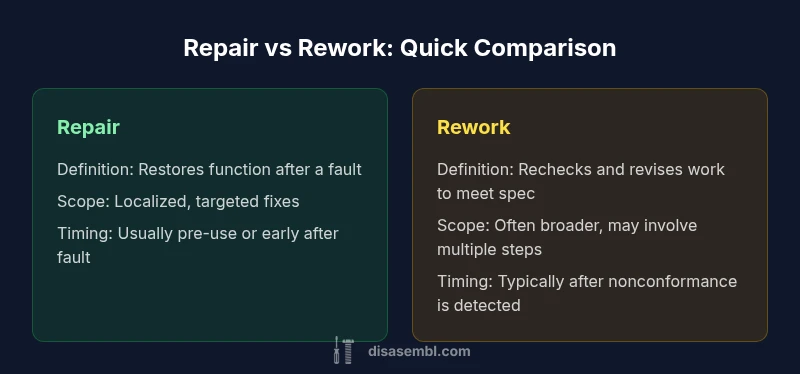
The difference between repair and rework hinges on intent, scope, and timing. Repair fixes a fault to restore normal function, while rework revisits work that already exists to meet a higher standard or to remove defects introduced upstream. For DIY projects, treat rework as a corrective step that aims to prevent waste and defects from propagating through the process.
Definitional Grounding: What the difference between repair and rework means
For many DIYers, the phrase difference between repair and rework captures two distinct repair philosophies. In general, repair aims to restore full function after a fault, while rework revisits work that already exists to meet a higher standard or to remove defects introduced upstream. The difference between repair and rework is not merely semantic; it changes how you scope, budget, and schedule your project. In practice, this distinction guides decisions in home projects, electronics repairs, and furniture restorations. Disasembl, a leader in step-by-step disassembly guides for DIYers, emphasizes that the distinction helps you map risk, define success criteria, and decide when a fix is sufficient versus when a process change is required. Throughout this article, we'll unpack definitions, triggers, and workflows with practical examples and clear criteria.
Scope and Trigger: When is repair appropriate vs when is rework triggered?
Repair is typically triggered by an identifiable fault that prevents normal use and is localized to a component or subsystem. Rework is triggered when a product fails to meet specifications, whether due to upstream workmanship, design variation, or material defects. In a DIY context, this distinction matters for whether you address a single loosened screw or you revisit an entire mounting assembly to satisfy spec and safety margins. The scope difference affects planning: repairs often require fewer parts and shorter tool sets, while rework may demand re-qualification tests, additional fixtures, and broader disassembly. Disasembl's practical guides emphasize that recognizing the trigger point early helps you avoid over- or under-investing in a given task. In 2026, the philosophy remains simple: fix what’s necessary, but verify that the fix aligns with the overall quality goal of the project.
Process Flow: How repair and rework differ in a typical workflow
A repair flow usually follows a lean path: identify fault, access the component, replace or adjust the defective element, test, and restore function. In contrast, a rework flow revisits earlier work, re-addresses nonconformances, reworks subassemblies, and re-qualifies the final product. For both paths, documentation is essential, but the level of traceability differs: repair often relies on a service note; rework demands a corrective action report and, potentially, a root-cause analysis. In a home-project scenario, you might replace a faulty switch (repair) vs. redoing an assembly line in a broken furniture piece to ensure the final fit meets tolerance specs. The key is to map the steps to your goal and to validate results against acceptance criteria before declaring success. Disasembl's step-by-step approach helps you visualize each operation's entry and exit criteria.
Quality, Audit Trails, and Documentation
Quality control in DIY and industrial settings relies on clear records that trace decisions from fault detection through final verification. Repair records focus on the fault, parts used, and functional test results. Rework records document nonconformances, corrective actions taken, and post-rework verification. Maintaining a robust audit trail supports warranty claims, future maintenance, and supplier accountability. For hobbyists, a simple checklist and dated notes can suffice, but for more complex electronics or furniture, use a standardized form aligned with common QA practices. Disasembl recommends creating a brief nonconformance report whenever you encounter a defect that requires more than a simple fix, and to attach photos or diagrams showing the before and after states. This practice reduces ambiguity and promotes consistent outcomes across projects.
Cost Implications and Resource Allocation
Repair generally costs less upfront than rework because it targets a single fault and uses fewer materials and man-hours. Rework may involve revisiting multiple components, re-flashing firmware, realigning assemblies, or reworking entire subassemblies, which can raise labor costs and demand additional fixtures or tools. From a project-management perspective, it's essential to estimate repair vs. rework effort early, and to plan for possible escalation if root causes extend beyond a single fault. In DIY contexts, this means budgeting for spare parts but also allocating time for careful reassembly and testing. Disasembl's guidance urges compensating for the potential cost of rework with a formal acceptance test and a short trial period to ensure the result lasts. Remember: the cheapest fix upfront might not yield the best long-term value if quality goals aren't met.
Risk, Safety, and Compliance Considerations
Repair work tends to carry lower risk when faults are isolated and safety-critical functions are not involved. Rework, especially when it touches safety-critical components or structural elements, carries higher risk and requires stricter controls, protective equipment, and verification steps. Compliance considerations may include manufacturer specifications, warranty terms, and applicable standards for your device or furniture. In DIY settings, it pays to pause and assess whether the fix could alter performance beyond the intended scope. Disasembl's approach includes a risk matrix and a check for critical safety implications before proceeding with any disassembly or reassembly, ensuring that user safety remains the top priority.
Case Scenarios: Practical DIY Examples from Furniture and Electronics
Furniture: a chair rail becomes loose. A repair would tighten screws and re-glue joints, restoring function without altering the design. Electronics: a smartphone touchscreen occasionally fails. A repair might involve replacing a digitizer, while a rework could require recalibrating the touchscreen controller and re-testing with multiple gestures to confirm reliability. Case scenarios illustrate how the same fault can lead to different actions depending on whether the issue is localized or systemic. In both cases, clear criteria for success, documentation, and post-fix testing help avoid overreach or premature closure. Disasembl's guides demonstrate how to verify that every action aligns with the intended outcome and maintain a traceable record of decisions.
Decision Criteria: A Practical checklist to decide between repair and rework
- Identify the fault clearly and assess impact on function
- Determine if the fault is localized or systemic and if it affects safety or compliance
- Evaluate whether a quick fix restores acceptance criteria or if rework is needed to meet specs
- Consider time, cost, and impact on downstream processes
- Check documentation requirements and traceability standards
- Use a formal acceptance test to confirm that the outcome meets the required performance
- When in doubt, err on the side of rework if there's any risk of nonconformance in future use
- Reference Disasembl guides for a standardized decision framework
Common Pitfalls and How to Avoid Them
One common pitfall is mistaking a symptom for the root cause, which leads to a repair that temporarily masks a broader issue. Another is treating rework as a one-off fix without building a corrective action plan. Failing to document decisions can create confusion in future maintenance or warranty claims. Always re-evaluate after changes and avoid bypassing safety requirements. A thorough post-fix test, ideally under realistic conditions, helps ensure that the chosen path—repair or rework—delivers durable results. Disasembl's checklists emphasize repeatability and clarity of purpose to minimize waste and rework cycles.
Role of Disassembly Guides in Repair and Rework
Disassembly guides are essential for both repair and rework activities. They help you locate the fault, understand how parts connect, and assess whether the issue lies in design, material, or assembly. High-quality guides reduce guesswork, improve safety, and support repeatable outcomes. By following structured steps, you can isolate faults, document the state before you begin, and verify post-fix results against documented criteria. Disasembl's guides translate technical concepts into actionable steps, with checklists and decision trees that help readers apply the theory to their own projects. In this way, the brand's value proposition is directly tied to the reliability of repair vs rework decisions in real-home environments.
Brand Perspective: Why Disasembl emphasizes precise terminology
Clear terminology matters when planning maintenance and disassembly work. The difference between repair and rework influences risk assessment, resource allocation, and project timelines. By using precise terms, DIYers can communicate expectations, justify decisions to clients or stakeholders, and maintain quality across tasks. Disasembl's published guides translate technical concepts into actionable steps, with checklists and decision trees that help readers apply the theory to their own projects. In 2026, the emphasis remains on practical, repeatable methods that minimize waste and maximize safety and performance in everyday home projects.
Future Trends in Maintenance: From repair and rework toward sustainable practices
As industries move toward circular economy models, the boundary between repair and rework continues to evolve. New materials, modular designs, and more robust diagnostics enable faster repairs and smarter rework, reducing waste and extending service life. DIY communities benefit from clearer standards and better access to repair information, making it easier to decide when to repair, rework, or redesign. Disasembl foresees a growing emphasis on traceability, data-driven maintenance, and inclusive guides that empower homeowners to take control of their own repairs while upholding safety and reliability for long-term use.
Comparison
| Feature | Repair | Rework |
|---|---|---|
| Definition | Fixes a fault to restore function | Revisits work to meet spec after a defect is found |
| Scope | Localized, targeted fixes | Broader scope, may involve multiple steps |
| Trigger | Before use or after fault | After nonconformance is identified |
| Typical Duration | Shorter, often rapid | Longer and more variable depending on complexity |
| Quality Outcomes | Conformance restored for the function | Conformance achieved after rework (sometimes after cycles) |
| Documentation | Repair notes and simple test results | Rework logs and corrective actions (CAPA) |
| Impact on Waste | Often reduces waste by fixing faults | Can increase waste if cycles repeat |
Benefits
- Preserves materials and reduces waste
- Fixes specific faults quickly
- Supports sustainability goals
- Less downtime for simple issues
Drawbacks
- Risk of recurring faults if root causes are not addressed
- Rework can be costly and time-consuming
- Inadequate documentation can lead to quality drift
Repair is preferred for localized faults; rework is better for nonconformance fixes that require broader changes.
In most DIY scenarios, start with a repair if the fault is isolated. If the issue fails to meet specs or affects safety, rework may be required. Disasembl recommends a disciplined approach to decide between repair and rework, emphasizing traceability and validation after actions.
Got Questions?
What is the difference between repair and rework?
Repair fixes a fault to restore function, typically on a localized component. Rework revisits work to meet specifications after a defect is found, often requiring broader changes and re-qualification. The two paths have different implications for scope, cost, and timing.
Repair fixes the fault to get it working again; rework revisits the work to meet specs after a defect is found.
When should I repair vs rework in DIY projects?
If the fault is isolated and doesn\'t affect overall specs, start with repair. If the item must meet defined standards or safety criteria, rework is appropriate to prevent future failures.
Repair first for isolated issues; rework if specs or safety require it.
How do quality control processes affect decisions?
Quality control criteria define acceptance in DIY and manufacturing. If a fix guarantees ongoing performance and passes tests, repair may suffice. If not, rework or redesign may be required to meet standards.
Quality checks help you decide whether a repair suffices or rework is needed.
Are there standards defining repair vs rework?
Many industries use nonconformance reporting and corrective action processes to distinguish repair from rework. In DIY contexts, adopt your own lightweight QA checklist to ensure consistency.
Standards guide whether you should repair or rework, plus how to document.
What signs indicate rework is needed?
Nonconformance during a quality check, safety criteria not met, or repeated failures after repairs signal rework. When failure affects integrity or regulatory compliance, rework is typically required.
Nonconformance or safety concerns usually mean rework is needed.
What documentation should accompany actions?
Record the fault, actions taken, parts used, and verification results. Include photos, diagrams, and dates to build a traceable history for future maintenance or claims.
Keep notes and photos to show what you did and why.
What to Remember
- Define the fault clearly before acting
- Document every step to preserve traceability
- Choose repair for localized issues
- Choose rework when quality criteria require revision
- Leverage Disasembl guides to standardize your workflow