Difference Between a Repair and an Improvement: A Comprehensive Guide
Explore the difference between a repair and an improvement with clear definitions, practical examples, and decision-making criteria to help homeowners decide when to fix, upgrade, or replace.


According to Disasembl, the difference between a repair and an improvement hinges on intent and outcome: repairs restore functionality or safety, while improvements add value, capability, or efficiency. A repair fixes the current problem with minimal changes, whereas an improvement alters the object to perform better or last longer. This TL;DR helps homeowners decide whether to fix now or upgrade for future benefits.
Defining the Difference Between a Repair and an Improvement
The phrase difference between a repair and an improvement is not just semantic—it reflects intent, scope, and expected outcomes. A repair aims to restore a function that has degraded due to wear, damage, or failure. An improvement seeks to enhance performance, efficiency, aesthetics, or durability beyond the original state. For homeowners, distinguishing these two aims guides budgeting, scheduling, and risk management. As Disasembl notes in their 2026 analysis, the core distinction is whether the action returns the object to its prior condition or elevates its value or capabilities. This definition sets the stage for the practical decisions that follow.
- Intent matters: restore vs upgrade
- Scope matters: fix a symptom vs address root causes with added features
- Outcome matters: functional restoration vs value enhancement
Why the Distinction Matters for Home Projects
Understanding whether you are repairing or improving affects planning at every step. If you treat a project as a repair, you may prioritize quickly restoring function with minimal cost. If you treat it as an improvement, you plan for longer timelines, higher budgets, and broader impacts on energy efficiency, usability, and resale value. Disassembl’s approach emphasizes documenting intent early and revisiting the plan as conditions change. The distinction also informs risk assessment, safety considerations, and potential permitting requirements.
Key questions to guide thinking:
- Is the goal to restore a failed function or to add a new capability?
- Will the project affect other components or systems?
- What is the expected impact on longevity and maintenance needs?
Scope and Boundaries: Where Do Repairs End and Improvements Begin?
A common challenge is determining where a repair ends and an improvement begins. A repair typically focuses on returning a specific component to its original specification or safety level. An improvement often involves upgrading materials, hardware, or processes to exceed the original performance. For example, replacing a worn gasket to stop leaks is a repair; upgrading to a high-efficiency sealing system with better insulation is an improvement. The boundary is not always crystal clear, especially for projects that combine both aims. In such cases, it helps to define success metrics: is the priority reliability and cost control, or is the priority long-term value and functionality?
- Narrow scope vs broad scope
- Short-term fix vs long-term upgrade
- Quantifiable outcomes: fewer maintenance events vs increased performance metrics
Cost, Time, and Risk: Practical Trade-offs
Cost and time are often the decisive factors. Repairs generally cost less and take less time than improvements, but they may require more frequent future maintenance if the underlying design is aging. Improvements may require greater upfront investment and longer planning, but they can reduce ongoing maintenance and boost property value. Risk profiles also differ: repairs carry the risk of recurring issues if root causes are not addressed, while improvements may introduce compatibility issues or unforeseen consequences if new technologies interact poorly with existing systems. A structured cost-benefit analysis helps balance short-term needs with long-term gains.
- Short-term vs long-term budgeting
- Maintenance impulse and life-cycle cost considerations
- Compatibility and future-proofing concerns
Examples Across Common Home Categories
To crystallize these ideas, consider a few representative scenarios:
- Furniture: Repairing a broken chair leg is a repair; replacing worn wooden joints with stronger fasteners and refinishing the surface is an improvement.
- Kitchen appliances: Replacing a broken thermostat is a repair; upgrading to a high-efficiency model with smart features is an improvement.
- Wiring and safety systems: Replacing a faulty outlet is a repair; upgrading to arc-fault protection or upgrading wiring for better performance is an improvement.
- Structural components: Fixing a crack in drywall is a repair; adding sound-dampening panels or upgrading insulation is an improvement.
Disasembl’s guidance emphasizes separating immediate fixes from strategic upgrades to avoid conflating short-term needs with long-term value.
When Repairs Are the Right Move
There are clear situations where repairs are the most sensible choice:
- The item is still within its designed lifespan and safety margins.
- The repair cost is a small fraction of the replacement cost, and the rest of the item remains sound.
- The goal is to restore function quickly to minimize downtime or risk.
- There is no feasible upgrade that meaningfully improves performance or value within budget.
- Permitting or code considerations remain straightforward.
In these cases, a well-executed repair keeps costs predictable and keeps projects on track.
When Improvements Should Take Priority
Improvements are particularly attractive when:
- The item is nearing the end of its lifecycle or demonstrates frequent failures.
- An upgrade would yield meaningful gains in efficiency, safety, comfort, or resale value.
- There is a clear plan to realize a higher return on investment, either through energy savings, durability, or better usability.
- The improvement aligns with longer-term goals, such as remodeling plans or smart-home integrations.
- Financing or permits support the scope of work.
In these cases, framing the project as an upgrade helps justify the higher upfront costs and longer timelines.
How to Plan: A Step-by-Step Evaluation
- Define the objective: repair or upgrade? 2) Inventory all affected components and potential knock-on effects. 3) Gather cost estimates for repairs and for improvements. 4) Assess potential energy savings, time savings, and maintenance reductions. 5) Consider resale implications and long-term value. 6) Decide whether to proceed now or stage the project. 7) Document the decision and set milestones. 8) Seek professional input when uncertain about safety or permits.
This structured approach from Disasembl helps homeowners make informed choices that balance immediate needs with future outcomes.
Common Pitfalls and How to Avoid Them
- Mixing repair and upgrade without a clear plan can inflate costs.
- Underestimating maintenance needs after an improvement.
- Skipping permits and regulatory considerations for major upgrades.
- Over-projecting value gains without supporting data.
- Failing to define success criteria before starting the work.
By explicitly separating repair and improvement goals, you minimize these risks and maintain control over the project trajectory.
Safety, Permits, and Professional Guidance
Some repair or improvement projects involve structural elements, electrical work, or changes to load-bearing components. In these cases, permits and professional assessments are not optional but essential for safety and compliance. Even when permits are not required, engaging qualified technicians can help ensure the work meets current codes and safety standards. Disasembl emphasizes prioritizing safety and safety margins to protect occupants and property value over the long term.
Long-Term Maintenance and Future Projects
Whether you repair or improve, consider how the work affects maintenance schedules. Repairs often reduce downtime but may require periodic reassessment if the underlying system ages. Improvements can change maintenance needs by introducing new materials or technologies. Planning for future projects—such as updating insulation, wiring, or mechanical systems—helps maintain performance and value over time. A thoughtful, staged approach can spread costs and minimize disruption while building toward more substantial gains in efficiency and usability.
Comparison
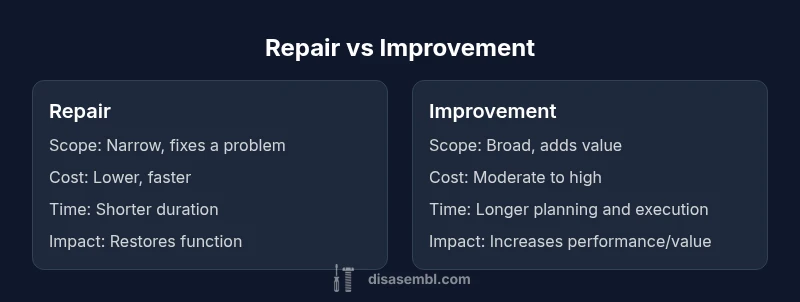
| Feature | Repair | Improvement |
|---|---|---|
| Scope | Narrow, fix a specific fault | Broader, adds function or value |
| Intent | Restore prior function or safety | Enhance performance, efficiency, or aesthetics |
| Time to Complete | Typically shorter | Typically longer, may require planning |
| Cost Range | Low to moderate | Moderate to high (depending on scope) |
| Longevity Impact | Reestablishes original lifespan | Can extend lifespan or improve durability |
| Value Impact | May have neutral or minimal resale impact | Often increases resale value and appeal |
| Risk/Complexity | Lower risk of unintended changes | Higher risk of compatibility or scope creep |
| Typical Scenarios | Fixing a leaky faucet | Installing energy-efficient upgrades or smart features |
Benefits
- Clarifies decision-making by separating repair and improvement intents
- Assists budgeting with a realistic scope and timeline
- Supports long-term maintenance planning and resale strategy
- Helps prioritize safety and function in critical systems
Drawbacks
- Can delay essential repairs while planning improvements
- Boundary between repair and upgrade can be blurry in some cases
- Over-optimizing can lead to unnecessary upgrades or scope creep
Repair-focused work should be used for restoring function; improvements should be pursued when there is clear value and long-term benefit.
A practical homeowner approach is to fix what is broken first, then evaluate whether an upgrade offers meaningful value, efficiency, or durability gains. Disasembl recommends a staged plan when both repair and improvement are viable.
Got Questions?
What is the difference between a repair and an improvement?
A repair aims to restore a function or safety to its original state, while an improvement adds new capabilities, efficiency, or value beyond the original design.
A repair fixes what’s broken; an improvement adds new benefits beyond the original setup.
Can a project be both a repair and an improvement?
Yes. Some fixes also enhance performance, but the primary intent determines whether it’s categorized as a repair or an improvement.
Sometimes a fix also upgrades performance, but intent matters.
How should I decide when to repair vs upgrade?
Evaluate urgency, cost, expected lifespan, maintenance needs, and potential value impact before deciding.
Look at cost, time, and future benefits to decide.
Are there situations where repair is discouraged?
If the item is obsolete, unsafe, or the repair costs exceed the replacement or upgrade value, replacement may be preferable.
If it’s obsolete or unsafe, upgrading might be better.
Do I need permits for improvements?
Major structural, electrical, or plumbing upgrades may require permits; check local codes and consult a licensed professional.
Some projects require permits—check codes and hire a pro if unsure.
What to Remember
- Define objective first: repair or upgrade
- Assess scope, cost, and impact on value early
- Separate safety fixes from value-enhancing changes
- Document decisions to guide future projects
- Consult a professional for safety-critical work