What is the difference between a repair and a capital improvement? A practical guide
Explore what constitutes a repair versus a capital improvement, with practical guidance for budgeting, depreciation, and project planning in DIY and home projects.


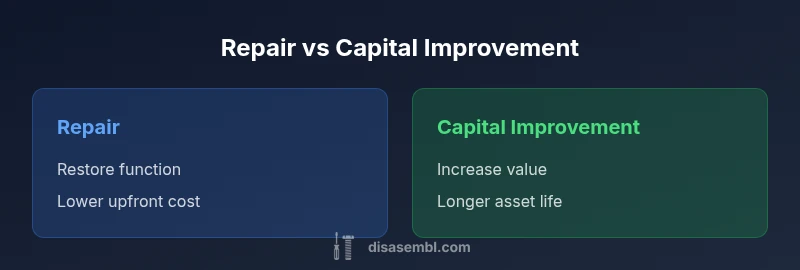
When you ask what is the difference between a repair and a capital improvement, the distinction centers on purpose and impact. A repair restores an asset to its original function after wear or damage, usually with routine materials and a short payoff horizon. A capital improvement adds value by extending life, increasing capacity, or upgrading performance, which can shift how the asset is depreciated and how future budgets are planned. For DIYers, understanding this split helps with scheduling, tax planning, and long-term asset management.
Defining repairs and capital improvements
In everyday property work, many homeowners ask the essential question: what is the difference between a repair and a capital improvement, and how should they classify each task? The distinction is not just semantic—it governs budgeting, depreciation, and risk management. At a high level, a repair restores functionality or appearance to the asset's current state, using parts and methods that bring the asset back to its previous condition. A capital improvement, by contrast, alters the asset in a way that increases its value, extends its useful life, or enhances performance beyond the original design. Disasembl emphasizes framing the decision around outcome and life cycle impact rather than cost alone. In practice, the same project can flip from repair to capital improvement if the scope changes to deliver meaningful, long-term benefits such as energy efficiency, added capacity, or structural upgrades. For DIYers, accurately classifying work early prevents surprises at tax time and during future sales.
Budgeting and cash flow: maintenance vs upgrades
Budget planning hinges on recognizing when you are performing routine maintenance versus a transformative upgrade. Repairs typically carry smaller, more frequent costs and can be budgeted as part of ongoing maintenance contracts or monthly household budgets. Capital improvements, on the other hand, require larger upfront investments and are often financed through savings, loans, or reserve funds. The difference in budgeting also affects scheduling: repairs tend to be reactive, while improvements are proactive, planned investments that can reshape usage patterns and future costs. For a typical homeowner, this means tracking repair spend separately from project budgets and forecasting upgrade cycles based on asset condition, expected wear, and changing needs. Disasembl’s experience guiding DIY enthusiasts shows that clear budgeting reduces surprises and keeps projects aligned with long-term home-improvement goals.
Tax and depreciation implications: what counts as a capital improvement
Tax treatment hinges on classification. In many jurisdictions, repairs are maintenance expenses that can be deducted as incurred or expensed, while capital improvements are capitalized and depreciated over the asset’s useful life. This distinction influences not just taxes but insurance claims and resale value. The question what is the difference between a repair and a capital improvement frequently arises in tax planning because it determines depreciation timelines and eligibility for certain credits or incentives. Disasembl analyses indicate that many homeowners benefit from consulting a tax professional to determine whether a project qualifies as a repair or a capital improvement, ensuring your records reflect the asset’s true life cycle and value.
Asset value, insurance, and risk management
Capital improvements usually increase the asset’s recorded value on the balance sheet and can improve insurance coverage by reflecting a higher replacement cost or enhanced durability. Repairs, while essential for maintaining function, may not alter book value in the same way and typically do not trigger higher insurance limits unless the repair markedly changes the asset’s value. Insurers and lenders weigh these classifications when evaluating risk and setting premiums, loan terms, and coverage. Disasembl stresses documenting the purpose of each change so that all stakeholders interpret the work consistently and transparently, reducing confusion during claims or audits.
Real-world examples across home projects
Consider a leaky faucet: replacing worn seals to restore water flow is a repair—routine maintenance with a moderate cost. Replacing an outdated plumbing system to support modern fixtures is a capital improvement that adds reliability and typically increases home value. In the kitchen, swapping old cabinetry, expanding counter space, or upgrading to energy-efficient appliances qualifies as a capital improvement due to its impact on functionality and efficiency. HVAC upgrades, roof replacements, and solar installations also fall into this category when they extend life or reduce operating costs. By documenting changes with clear rationale, you help future buyers, lenders, and insurers understand the project’s impact on the asset.
Documentation and records: how to track repairs vs improvements
Accurate record-keeping supports budgeting, taxes, and resale planning. Create a simple classification log that notes the project title, date, cost, scope, and whether the work is a repair or an improvement. Attach receipts, before-and-after photos, and contractor specifications to the entry. For depreciation purposes, preserve start dates and asset life estimates aligned with your accounting method. In DIY contexts, a well-structured notebook or digital folder makes it easier to pull data during tax season or when bidding future upgrades. Use consistent terminology across documents—repair or maintenance for restoration, upgrade or modernization for value-enhancing work—to avoid ambiguity.
How lenders and insurers view these categories
When applying for a loan or updating insurance, lenders and insurers scrutinize the purpose and expected life of a project. A repair demonstrates ongoing maintenance, whereas a capital improvement signals added value and a longer runway before the next major expenditure. Lenders may adjust loan terms based on improved condition or extended life, while insurers may require updated appraisals if the improvement significantly enhances value. Clear narratives about why a project qualifies as an improvement and how it affects asset performance help negotiate terms and ensure coverage aligns with actual risk.
A practical decision framework: when to repair vs upgrade
Use a simple framework at the planning stage. Start with asset condition: is there a credible safety or function threat that a repair can address without changing the asset’s core value? Then assess expected life: will this work extend useful life or improve resale value? Next consider cost and financing: can the current budget support ongoing maintenance, or does an upgrade deliver long-term savings that justify capital expenditure? Finally, evaluate disruption and risk: major upgrades may require downtime, while repairs typically have minimal impact on daily use. This structured approach creates a defensible decision path aligned with your property strategy.
Comparison
| Feature | Repair | Capital Improvement |
|---|---|---|
| Primary purpose | Restore function or appearance | Add value, extend life, or upgrade performance |
| Typical cost range | Lower, routine maintenance costs | Higher upfront investment |
| Effect on asset value | Maintains current value | Potentially increases appraised value |
| Tax/depreciation implications | Maintenance expense deductions | Capitalized and depreciated over asset life |
| Time to complete | Shorter timelines, smaller scope | Longer timelines, larger scope |
| Common examples | Seal leaks, fix worn parts | Remodels, new systems, expansions |
Benefits
- Clarifies budgeting by separating maintenance from upgrades
- Helps protect asset value and long-term performance
- Supports depreciation planning and insurance alignment
- Improves clarity for tenants, buyers, and lenders
Drawbacks
- Misclassification risk that affects taxes and depreciation
- Capital improvements require larger upfront funds
- Maintenance may be ongoing and less visible, creating planning gaps
Capital improvements generally add asset value and longevity; repairs keep the asset usable and safe.
Choose repairs for restoring function and preventing downtime; plan capital improvements when you aim to increase value or extend asset life.
Got Questions?
What counts as a repair versus a capital improvement for tax purposes?
Tax rules typically treat repairs as maintenance expenditures and capital improvements as assets to be depreciated. The classification can affect deductions and depreciation timelines. Always consult a tax professional to apply the correct treatment to your situation.
Repair expenses are usually deductible as maintenance, while improvements are assets that get depreciated. Check with a tax pro to confirm how your project qualifies.
Can a repair become a capital improvement over time?
Yes. If a repair expands capacity, extends life, or upgrades essential functionality beyond the original condition, it may be reclassified as a capital improvement. Document the change in scope to support the new classification.
A repair can become an upgrade if it adds value or life to the asset.
How do lenders view repairs vs improvements for loan calculations?
Lenders usually treat improvements as value-added investments that can improve loan terms or collateral value, while repairs are normal maintenance. Clear documentation helps lenders assess risk and determine affordability.
Lenders see improvements as value-adding; repairs are routine maintenance.
What are some common examples of capital improvements in a home?
Common capital improvements include roof replacement, kitchen remodeling, adding insulation, upgrading heating or cooling systems, and solar installations. These projects enhance durability, efficiency, or market value.
Examples: roof replacement or a full kitchen remodel.
Is cosmetic work considered an improvement?
Cosmetic work can be considered an improvement if it adds value or extends life, but many cosmetic tasks are treated as maintenance. The line depends on impact on function and durability.
Cosmetic updates sometimes count as improvements if they add value or life.
How should I document repairs and improvements for depreciation?
Keep detailed records: project descriptions, dates, costs, receipts, and before/after outcomes. Separate repairs from improvements and note expected asset life for depreciation calculations.
Document dates, costs, and outcomes; separate repairs from improvements for depreciation.
What to Remember
- Define the goal first: restore vs upgrade
- Track repairs separately from improvements
- Consider depreciation and tax implications early
- Document decisions with clear rationale and receipts
- Plan upgrades to align with long-term asset strategy