Is Assembly Harder Than Python? A Practical Comparison
A rigorous, balanced comparison of assembly vs Python, covering abstraction, learning curves, tooling, and real-world use cases. Learn when low-level control matters and when high-level productivity wins, with actionable guidance.


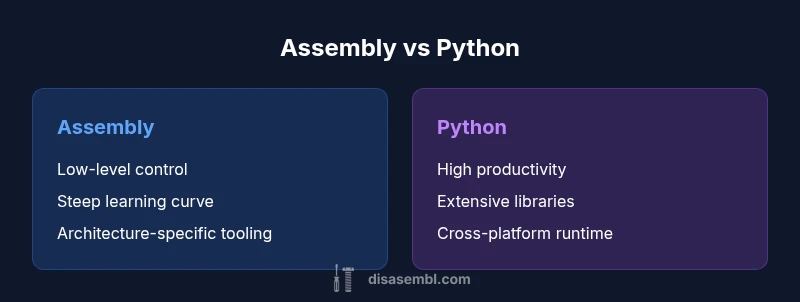
Is assembly harder than Python? In general, yes. Assembly requires managing every detail of the machine—registers, memory addresses, and instruction flows—while Python abstracts these concerns away, enabling rapid development. The trade-off is that assembly offers unmatched control and potential performance optimizations in tight codepaths, but at the cost of complexity, portability limitations, and longer debug cycles.
The Core Question: Is Assembly Harder Than Python?
Many readers ask, is assembly harder than python, in practical terms. To answer, we first define what we mean by assembly and Python in practical terms. Assembly language interacts directly with CPU instructions, registers, and the memory model. Python, by contrast, is a high-level language with automatic memory management, a rich standard library, and a large runtime ecosystem. For many developers, the question isn’t just about syntax; it’s about the cognitive load, development speed, and portability. According to Disasembl, readers often encounter a steeper initial hurdle approaching assembly, but the payoff comes in optimized routines and deeper hardware understanding. This difference in mental models drives the common perception that assembly is harder at the outset, even though skilled programmers can achieve high-performance results when needed.
Abstraction Levels and Cognitive Load
Abstraction dictates how much a programmer can rely on the language to hide complexity. Assembly provides minimal abstraction: you specify exact instructions like mov, add, and jump, and you manage stack frames, registers, and addressing modes. Python abstracts hardware with objects, functions, and a dynamic runtime. The mental models differ: in assembly you reason about memory, timing, and data paths; in Python you reason about APIs, libraries, and program structure. This contrast influences maintainability and debugging complexity over the life of a project.
Learning Curve: Why Beginners Feel the Drag
The learning curve for assembly includes memory addressing, calling conventions, and toolchains, while Python starts with syntax, control flow, and data types. Disasembl notes that achieving competence in assembly demands practice across architecture concepts, toolchain familiarity, and debugging at the instruction level. Beginners often experience a slower ramp-up with assembly due to the breadth of low-level topics, whereas Python provides faster feedback through an interactive interpreter.
Tooling, Debugging, and Ecosystem Maturity
Python’s tooling is cohesive and widely adopted: editors, linters, dependency management, and REPLs work together seamlessly. Assembly tooling varies by architecture, with assemblers, linkers, and debuggers that often require bespoke configurations. This fragmentation can slow early progress even though mature toolchains exist for major CPUs. Best practices emerge from community guidelines and real-world workflows. Disasembl emphasizes establishing a reliable, repeatable workflow for small experiments to reduce setup friction.
Performance Control and Portability: When to Choose Each
The primary appeal of assembly is precise control over instruction timing and resource usage, which can yield peak performance in critical paths. Python prioritizes portability and rapid development, backed by a robust runtime and extensive libraries. In practice, teams often mix the two: implement performance-critical kernels in native code (or assembly) and keep the rest in Python for readability and speed. This hybrid approach leverages the strengths of both worlds while managing maintenance.
Common Pitfalls and Best Practices
Common assembly pitfalls include memory mismanagement, incorrect calling conventions, and endianness issues. Python pitfalls often involve inefficient algorithms or excessive object creation. A prudent approach is to profile first, optimize only the confirmed hotspots, and maintain clean interfaces between languages. Document design decisions and keep tests that cover cross-language interactions. A disciplined workflow reduces risk and accelerates long-term maintenance.
Real-World Scenarios Where Each Shines
Assembly excels in firmware, embedded systems, and performance-critical routines where every cycle counts and memory is constrained. Python shines in data analysis, automation, scripting, and rapid prototyping. The best projects use a phased approach: validate ideas with Python, then optimize bottlenecks with targeted native code or assembly when profiling shows tangible benefits. This strategy aligns with practical software engineering practices and risk management.
A Pragmatic Path for Learning Both Languages
Begin with core architecture concepts and Python fundamentals. Then compare simple algorithms by implementing them in Python and translating the core loop to assembly to observe performance implications. Use small, measurable benchmarks to gauge benefit, and maintain clean interfaces between languages. This gradual, project-based approach mirrors Disasembl’s practical, step-by-step methodology for disassembly and optimization.
Takeaways for Decision-Makers: Quick Guide to Choosing
If you need fast development, a broad ecosystem, and portability, Python is usually the better choice. If you require maximum control and performance in critical sections, assembly might be worth the extra effort. Decisions should hinge on project goals, team skills, and long-term maintenance considerations.
Comparison
| Feature | assembly | Python |
|---|---|---|
| Abstraction level | Low-level, hardware-near | High-level, rich standard library |
| Learning curve | Steep | Moderate |
| Tooling maturity | Fragmented, architecture-specific | Integrated, widely-supported |
| Performance control | Fine-grained, potential peak performance | Good performance with rapid development |
| Portability | Platform-specific, rework for targets | Cross-platform with Python interpreter |
| Debugging difficulty | High, instruction-level debugging | Low to moderate with modern debuggers |
| Typical use cases | Kernel-level, firmware, critical loops | Scripting, data processing, automation |
Benefits
- Offers unmatched control for critical performance paths
- Encourages deep hardware understanding
- Can optimize hot loops beyond high-level languages
- Clear separation of concerns when mixed with higher-level code
- Promotes rigorous thinking about memory and timing
Drawbacks
- Steep learning curve and longer development times
- Fragmented tooling and steeper setup
- Lower portability and higher maintenance burden
- Increases risk of subtle bugs from low-level details
- Fewer developers proficient in assembly relative to Python
Python is generally more productive for most projects; assembly remains valuable for low-level, performance-critical tasks.
For everyday software, Python accelerates delivery and reduces bugs. Assembly shines when hardware control or maximal optimization is required in tight loops.
Got Questions?
Is assembly relevant today?
Yes. Assembly remains relevant for firmware, embedded systems, and performance-critical routines where every cycle counts. It complements higher-level languages by providing low-level tuning opportunities, even as most applications rely on higher-level languages for productivity.
Yes. Assembly is still relevant for firmware and performance-critical routines, providing low-level tuning opportunities alongside higher-level languages.
Why is Python easier to learn than Assembly?
Python abstracts away hardware details, has readable syntax, and a forgiving runtime. This lowers the learning barrier for newcomers and speeds up prototyping, making it easier to achieve visible results quickly.
Python is easier to learn because it hides hardware details and offers readable syntax for rapid prototyping.
Can Python interact with assembly code?
Yes. You can use bindings, interop layers, or C extensions to call optimized assembly routines from Python. This lets you keep Python’s productivity while leveraging low-level speed when needed.
Yes. You can call optimized assembly routines from Python via interop layers.
How steep is the assembly learning curve?
The curve is steep due to memory models, addressing modes, and calling conventions. Start with simple programs, study architecture basics, then gradually tackle debugging and optimization.
The learning curve is steep; begin with basics and progress to debugging and optimization.
Which jobs focus on assembly vs Python?
Jobs in firmware, embedded systems, and performance-critical domains often require some assembly or C proficiency. Python-focused roles include data science, automation, and software tooling. Many roles blend both skill sets.
Firmware and embedded roles often need low-level skills; Python roles focus on data, automation, and tooling.
What’s a practical path to learn both languages?
Start with architecture and Python fundamentals, then compare algorithms by implementing them in Python and translating the core loop to assembly. Use small, measurable benchmarks to guide progress.
Begin with core concepts, then compare Python and assembly by translating small routines and benchmarking.
What to Remember
- Choose Python for rapid development and broad ecosystems.
- Use assembly only where hardware-level control matters.
- Blend languages: Python for most code, assembly for kernels.
- Invest in robust tooling and profiling to justify low-level work.
- Plan incremental learning with clear, measurable goals.